14

I was reading in the papers how some-airline-or-the-other increased their prices for extra luggage, citing increased fuel costs.

Now I'm a bit skeptical. Using the (wrong) Bernoulli-effect explanation of lift, I get this:

More luggage$\implies$more lift needed $\implies$ more speed needed$\:\:\:\not \!\!\!\! \implies$more fuel needed. At this point, I'm only analysing the cruise situation. When the plane is accelerating, this will come into effect, but more on that later.

Now, I know that the correct description of lift involves the Coanda effect and conservation of momentum, but I don't know it well enough to analyse this. Also, there will be drag forces which I haven't (and don't know how to) factored in. I can see that viscosity must be making a change (otherwise planes wouldn't need engines once they're up there), but I don't know how significant a 1kg increase of weight would be.

So, my question is: Are airlines justified in equating extra baggage to fuel?

Bonus questions:

  • If more baggage means more fuel, approximately what should the price be for each extra kilo of baggage?
  • What happens when we consider takeoff and landing? Does a heavier plane have to use a significantly large amount of fuel?
Manishearth
  • 19,167
  • 6
  • 64
  • 104

8 Answers8

14

In your own question you recognize that the Bernoulli equation is the wrong thing to apply to this situation, because obviously there are dissipative losses involved.

My preferred way of looking at this is recognizing there is a lift to drag ratio that exists as a metric for aircraft. This can be 4:1 or 25:1 depending on the plane. Regardless, provided that we accept the existence of this ratio in the first place, then the airlines are justified in the claim that more weight $\rightarrow$ more fuel. Limiting the discussion to cruising, it then becomes a simple multiplication of weight times lift to drag ratio to find fuel use.

The other flaw in your argument is, of course, the assumption that speed can be increased to compensate for more weight. A cursory reading into the flow path of turbo-machinery will disprove this. The jet engines will be most efficient at the designed cruise speed and rotation speed, and any deviation from that will alter the angles at which the air hits the rows in the turbine, causing efficiency to decrease. In the real world, drag also tends to increase as some power of velocity, which in itself will probably predict some marked decrease in the lift to drag ratio, again, making the plane consume more fuel. If the plane uses different altitudes to compensate for different weights with the same velocity, then more dense air will obviously cause more drag. It's true that these are ultimately viscous losses, but this flow is turbulent, and its likely that drag will scale as something close to $\propto \rho v^2$ (density times velocity squared) as a result of that fact. As the density increases fuel consumption will too.

Alan Rominger
  • 21,318
4

One thing in your argument is that more lift, means a higher speed. This may not be what airliners do. Airplanes (at long flights) choosse their cruising altitude based on their weight. Higher weight means lower altitude. I think this should be included in the incremental cost calculation of additional piece of luggage.

First, simple Google hit: http://www.ehow.com/about_4572148_why-do-planes-fly-feet.html . Some of the physics aspects are however mentioned here, that can be used in your derivation.

Bernhard
  • 5,085
4

Lift is roughly proportional to angle of attack, and to speed squared. As a pilot, you instinctively balance these two.

ADDED: Like if you suddenly drop a heavy weight, making the plane lighter, its lift isn't any less, so it starts to accelerate upward (climb). You notice this and either push the nose down with the trim wheel (lessen the angle of attack, making the plane go faster at the same power) or reduce throttle to reduce speed because you need less lift at the original angle of attack. Or, you do both, and stay at the same speed.

Drag is the sum of parasitic drag (that's mainly your viscosity) and induced drag (drag due to lift). More lift, more induced drag. More drag, more power needed.

Mike Dunlavey
  • 17,328
3

Some numerical values:

Althought he didn't explain his calculations, according to Tony Webber, former Qantas Group chief economist, the costs of 2 extra kilograms per person are:

These increases represent weight gains of around 0.23 per cent and 0.20 per year for woman and men, respectively. Since 2000, the extra loading that an average adult passenger carries is about 2 kilos.

All adds up

So what does this increase mean for additional fuel consumption on a big, modern aircraft like the A380?

On a route like Sydney to London via Singapore, it means around 3.72 extra barrels of jetfuel per flight is burnt, which at current prices cost about $472.

Source

Mind you, this is for every person on the aircraft carry an extra 2 kgs. As an average Quantas A380 has 484 Passengers , and with 159 liter per barrel this will cost

$ \frac{3.72 \cdot 159}{484 \cdot 2}=0.61 $ Liter per kg taken.

Or €1.81 per kg taken, using Webbers prices.

ROIMaison
  • 761
3

I am not sure that "more lift needed ⟹ more speed needed", as another way to increase lift is to increase the angle of attack (http://www.centennialofflight.gov/essay/Dictionary/four_forces/DI24.htm ). But I guess in both cases (if either speed or the angle of attack is increased to increase lift) drag is increased, so fuel consumption is increased. I don't know how big this increase may be.

akhmeteli
  • 27,962
2

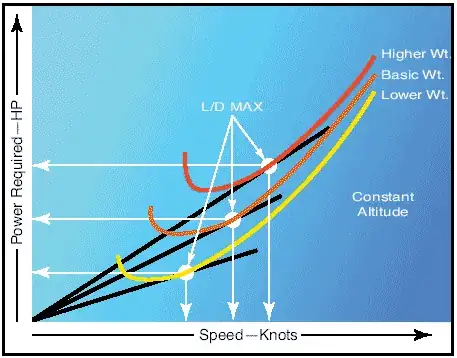
I've found in this website an interesting plot. In particular figure 12 shows some polar curves vs weight*:

enter image description here

It is possible to note that bigger weights requires more engine power to maintain the altitude for every given fixed speed. Plus we must take into account the extra fuel spent to take an extra bag from ground to 900 km/h at 12 km altitude (that cannot be recovered during the descend). Summing everything up I think that the airlines are totally justified to charge an extra fee for heavy luggages, still the magnitude may be object of discussion.

*: This plot is slightly different from the one that glider pilots are used to see: as the power $P=Fv$ and increasing the weight we boost both $F$ and $v$, the vertical axis plotting the power is not in linear relation with the one plotting the vertical speed.

DarioP
  • 5,205
1

I was reading in the papers how some-airline-or-the-other increased their prices for extra luggage, citing increased fuel costs.

I suspect the explanation for this is much more in the realm of economics than physics. The increasing price of fuel greatly increases the airline's total expenses. In order to meet these expenses, the airlines need to take in more revenue. Baggage fees--and fees for onboard snacks, for more legroom, and everything else--help provide this revenue. When the airline cites "increased fuel costs" when explaining a baggage fee, I expect that they are referring not to the marginal cost to carry an extra 10 kilos, but rather their bottom line after all income and expenses are accounted for. The only physical principle involved is "conservation of dollars".

The existence of baggage fees in the first place most likely is also best explained via simply supply-and-demand economics. Every aircraft has a maximum allowed gross takeoff weight. If the combined weight of the aircraft, its fuel, passengers, and cargo is beyond the maximum take-off weight, the flight cannot take place safely or legally. Charging a fee for baggage discourages passengers from bringing too much. The fee allows a scarce resource to be allocated effectively while providing revenue to the airline.

That said, I would be quite curious to know what the marginal cost to carry a small amount of extra weight actually is.

nibot
  • 9,691
0

Lift is a dynamic process. To hold itself up, the plane has to accelerate air downward. The more the plane weighs, the more downward force it exerts on the air, and hence the more work it does on the air. In turn, this means the plane expends more energy.

That work the plane is doing is experienced as drag. Much, maybe most, of the drag on an airplane isn't just a result of insufficient streamlining. Rather, it is fundamental to keeping the plane in the air. This is the reason a plane has a specified lift-to-drag ratio.

Mark Foskey
  • 3,965