22

This morning it was particularly foggy and my son was excitedly looking at the sun through the fog, since of course he normally can't look directly at it and see the disk. I told him to stop looking directly at it and said that the fog blocked some wavelengths but not others, and so it could still be dangerous.

Given that he's 7 years old, I'm sure it was the right advice from a parenting perspective (we can worry about nuance when he's older, and fogs can shift quickly). But was it correct from a physics perspective? Does a dense fog allow through invisible wavelengths (which might be harmful to the retina), or does it block other wavelengths the same as visible light?

David Z
  • 77,804

3 Answers3

17

The damage to the eye from looking at the Sun is thought to be due to high intensity light creating free radicals that attack the cells in the retina. Contrary to popular belief it isn't a simple burning process.

To a first process fog attenuates all (visible) wavelengths equally, which is why it's white. If it preferentially absorbed some wavelengths it would cause a colour change. If you're interested in the details a quick Google found this article on light attenuation by the various forms of fag, cloud etc.

So fog doesn't let through potentially harmful wavelengths whilst blocking others. It blocks everything.

Nevertheless I strongly approve of your advice to your son - looking at the Sun is a bad habit to get into!

John Rennie
  • 367,598
7

I think that from a medical perspective your advice was correct, but your physical explanation of why was not.

The wavelength dependence of the extinction due to fog depends on the distribution of particle sizes. If the particles are bigger than the wavelength of light, then the (Mie) scattering and extinction become independent of wavelength, and this I think is the usual case - Price (2010) provide a brief review and some data for fogs and the consensus seems to be that typical droplet sizes are 10-20 microns, though can be bigger or smaller depending on exactly what type of fog/mist it is. Grabner & Kvicera (2011) discuss this in some detail and show (model) curves of extinction versus wavelength that are quite flat across the optical and UV ranges (though do allow more IR light through) unless the fog particle size falls below the wavelength of light.
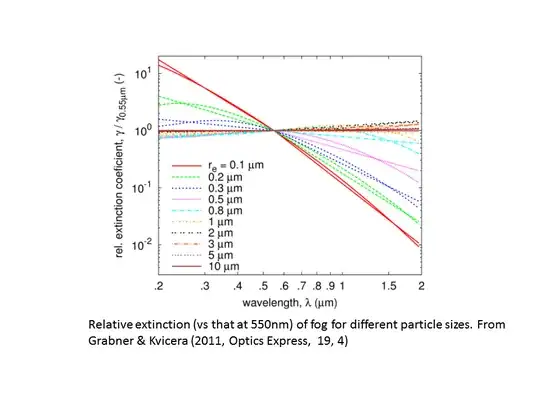
Extinction due to fog

Now, if you think that the problem with the Sun is due to UV light entering the eye, then the effect of fog would simply be to allow you to expose yourself to more UV light, as the attenuation at other wavelengths would also stop the reflex you would normally have to blink or turn your eyes away or for your pupils to narrow.

Thus although there may not be any acute damage caused by looking at the Sun through fog, you would certainly be increasing your long term exposure to short wavelength radiation if you got into the habit of doing it, possibly leading to cataracts and macular degeneration. The risk is thought to be cumulative. A brief look at some sources suggests that recommended sunglasses block much more (or even all) UVA and UVB radiation (290-400nm) compared to longer wavelength radiation for this very reason. Fog is like "grey" sunglasses, allowing you to damage your eyes without the acute sensations which tell you that damage may be occurring

Absent a contrary medical opinion, I would say that UV light from the Sun is particularly harmful and I would not stare at the Sun through fog.

ProfRob
  • 141,325
3

To add to the other answers: without detailed analysis of the light passing through fog, one cannot infer that, just because fog dims the Sun to a level that makes staring at it comfortable, therefore it is safe.

The "brightness" of the Sun, and the discomfort that staring at it induces, is only very weakly related to the damage it can do. Indeed, a healthy retina can easily handle the heating effect that staring at the Sun at high noon will impose on the retina. What makes the light dangerous is its UV content, which damages the retina through phototoxicity, not heating damage. And very low levels of UV can be damaging, especially for little children. The eye's lens attenuates UV significantly by the age of 20, but in children it is greatly more transparent to harmful UV.

The reason comfort in looking at the Sun is not a good guide to safety is because staring at it induces temporary blindness (that rights itself after a few minutes) - not a good situation for prey or predator animals (we are both), so it is a strong evolutionary driver to evolve a blink / aversion response. But this is not the reason sunlight is a concern now: the effects of Sun UV - cataracts and retinal cancer - usually show themselves too late in life for them to be an evolutionary driver (our forebears were mostly dead from being eaten or whatnot long before these diseases showed themselves).

See my answer here which gives some more info and also cites some gruesome animal experimentation illustrating the above.

Selene Routley
  • 90,184
  • 7
  • 198
  • 428