In the book 'An introduction to science of cosmology' by Raine and Thomas, they have two equations $$ \frac{\Delta T}{T} = \frac{v}{c}\cos\theta'\qquad (4.14) $$ $$ T = (3.372±0.014)×10^{-3}\cos\theta' K \qquad (4.15) $$ From these two relations the velocity of solar system relative to CMB has been written as $371\pm 1$ km/s in the direction $(l = 264.14\pm 0.3^{\circ},\ b = 48.26\pm 0.3^{\circ})$. How do we arrive at this velocity and direction.
Asked
Active
Viewed 1,630 times

2 Answers
5
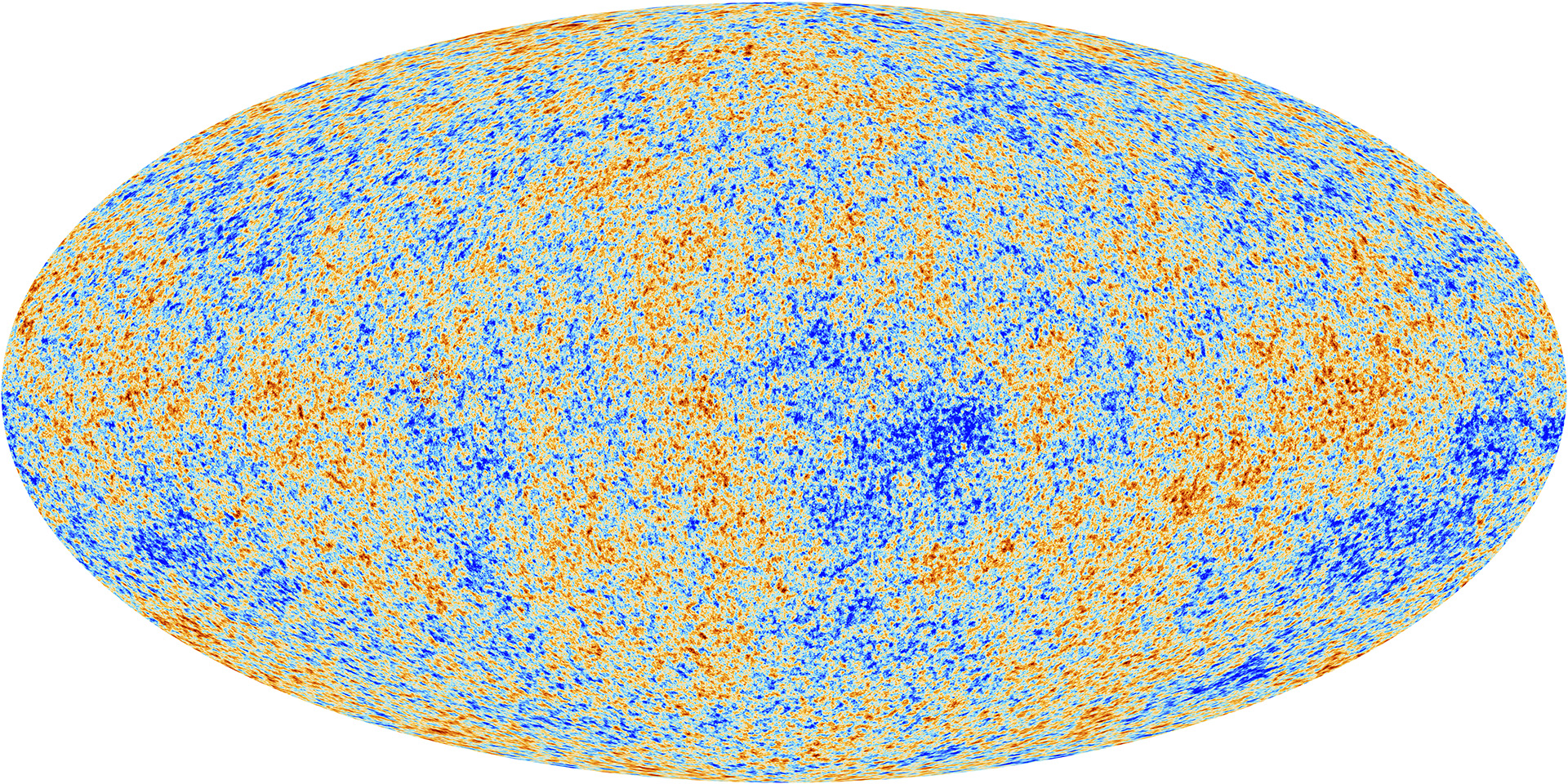
First, you make a measurement of the CMB temperature map. With the average temperature subtracted off, this looks like:

The main feature to see here is a clear dipole, the signature of the doppler shift caused by the motion of the detector relative to the CMB rest frame. There's also a bit of fuzz visible along the equator from galactic foreground sources. The actual cosmologically interesting CMB signal is buried under the overwhelming dipole and foregrounds.
To get a measurement of the velocity, one simply fits a dipole to the map (with the monopole, or mean temperature, already subtracted off), which looks like your equation 4.14. Your 4.15 looks a bit fishy to me out of context, because if $\theta'$ ranges from $0$ to $2\pi$, you'll get negative values for temperature. I don't think it's actually needed, in any case. Once the dipole is fit you'll know which direction the motion is in (I'm guessing $\theta'$ is defined as an angle offset from some reference angle), and its magnitude ($v/c$). From there it's just a matter of converting to galactocentric coordinates $(l,b)$.

Kyle Oman
- 18,883
- 9
- 68
- 125
4
If we are moving relative to the CMB then CMB photons will be doppler shifted (and the amount depends on the direction relative to the CMB frame). This induces a dipole in the temperature fluctuation map
$$T(\theta) = T_0(1+v/c\cos\theta)$$
to first order in $v$, which we can measure. The direction and velocity can for example be found by fitting a dipole to CMB temperature maps produced by e.g. WMAP and Planck. For more details on how it's acctually done in practice you see for example the Planck article on the Doppler boosing of the CMB.

Winther
- 688