As everybody knows Jupiter is made up of gases and these gases mainly contain hydrogen and helium. Since light passes through gases and does not reflect when shining on them, how we are able to see Jupiter? What is the physics behind it?
Asked
Active
Viewed 1,837 times

2 Answers
9
In general, what you see in Jupiter's atmosphere is simply clouds: large collections of small liquid droplets floating in the atmosphere. Liquid droplets are excellent at scattering light in any direction, and indeed one can visually see clouds on Earth with some regularity.
In fact, it is indeed possible to observe 3D details on these clouds. Here is an example from Saturn:
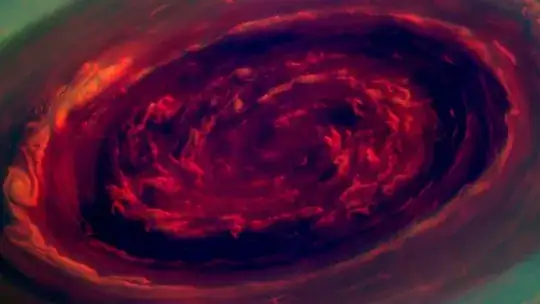
It is clear that most of the reflected light comes from clouds, which are bathed in a (mostly) transparent atmosphere.
The Wikipedia article on Jupiter's atmosphere makes it clear that it is indeed the clouds that are visible. These inhabit the troposphere, and there are another three layers of atmosphere (stratosphere, thermosphere and exosphere) sitting on top of it which are mostly transparent (much like Earth!).
However, you should also note that:
- Gases are transparent but only up to a point, and they do scatter light in all directions (including backwards). In fact, the air on Earth's surface does scatter light, which is why the sky isn't black. What matters is the thickness of gas that the light must travel through - a few meters in air is fine, but, on the other hand,
- Jupiter is big. Like, really big. If it was in fact simply made of hydrogen and helium at constant atmospheric pressure and density, you still wouldn't be able to see through it.
Jupiter is made (mostly) out of hydrogen and helium, but that doesn't mean that the hydrogen and helium are gaseous. As you descend into Jupiter, the gaseous atmosphere smoothly transitions into liquid, and then you meet a mantle made of metallic hydrogen. The centre is a core of ice and rock.
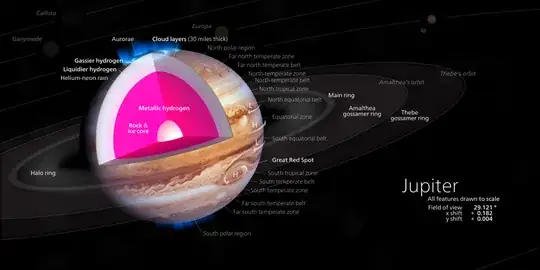

For a better look at Jupiter, I heartily recommend Phil Plait's Crash Course Astronomy:
 .
.

Emilio Pisanty
- 137,480
2
Jupiter is cloudy. It's upper atmosphere contains clouds of ammonia, ammonium hydrosulfide and water. These clouds reflect light just as clouds made up of water droplets reflect light in Earth's atmosphere.
We should note that no gas is completely transparent, even if only because of Rayleigh scattering. The sky on Earth looks blue because our atmosphere scatters light - the colour is because it scatters blue light more than red light. However the majority of the light we see coming from Jupiter has been refleted from the tops of clouds.

John Rennie
- 367,598