I am going to ask a really stupid question here. It is a very well known fact that gravity is inversely proportional to the distance squared between two masses. I understand how he arrived at this idea using Kepler's law and centripetal acceleration. But I was wondering how he found out that gravity is proportional to the product of two masses. Is this something obvious that I am too dumb realize or is there other proof behind this?
Asked
Active
Viewed 3,847 times

2 Answers
21
If you assume that one mass does not inhibit the force from any other mass, then the result follows from the multiplicity of all pairwise interactions.
Without loss of generality* you can imagine partitioning each object into an integer number of small pieces, all of the same mass. Then the force of each piece in one object on each piece in the other object must all be equal. The number of these small pairwise interactions is the product of the number of pieces, which is proportional to the product of the masses.
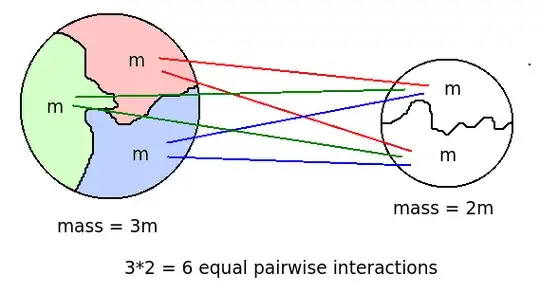
*If one objects mass is an irrational multiple of the other, use a sequence of successive rational approximations.

Nick Alger
- 2,790
5
You can't figure it out just from Kepler's law. An electron orbiting a proton will follow the same path, even though force has nothing to do with the masses of the proton and the electron. However, there are a few basic assumptions that will make it clear.
If the force wasn't proportional to the falling mass, then different bodies would accelerate at different speeds. This would pull planets apart. Since this isn't happening, we know that proportionality works. Also, we know this from older gravitational theories. All objects accelerate at the same rate from gravity, so it must pull proportional to mass. If it didn't, two bowling balls tied together by a tiny string would fall at a different rate than each of them falling separately.
If you accept the law of action and reaction, or in Newton's case, if you discover that law, then gravity must also be proportional to the mass of the object doing the pulling. Another way to see it is to imagine the solar system having two suns in the middle. Planets would be pulled to each of them, and would experience twice the force. This won't tell you that it's proportional to mass rather than, say, electric charge, but if you've been paying attention this far, mass would be the obvious thing to guess.

DanielLC
- 1,699