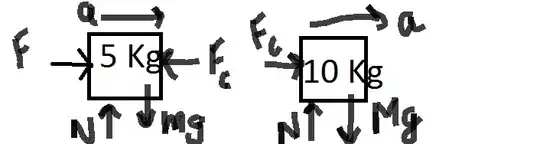
A $5$ kg and a $10$ kg box are touching each other. A $45N$ horizontal force is applied to the $5$kg box in order to accelerate both boxes across the floor. Ignore friction forces and determine the force between the hand and the boxes.

Considering the body as a single mass, we can find the acceleration of the body as $3\ \mathrm{ms}^{-2}$. The force between the blocks can similarly be found as $30\ \mathrm{N}$. But coming to the question, I cannot be sure as to whether to take the two blocks as a single body. If I do so, then as per my understanding of Newton's Third Law, the hand should experience a force of $-45\ \mathrm{N}$. Now, despite my hand experiencing an equal force in the opposite direction, I am able to keep contact with the block and continue pushing the 2 blocks over a distance (say $d$). Could someone please help me by explaining why this is so? Thanks a lot!
(This is not an original question. I had come across it 'the Physics Classroom' and thought of this variant.)