0

From what I have learned, objects must accelerate as they approach a heavy mass. But I also know that they cannot travel faster than the speed of light.

What if you had a proton travelling at .99999c towards a heavy object? Would it have to keep accelerating or would the acceleration of the proton slow down to zero and only it's mass would increase?

Edit: If the latter is true, then why do we describe a gravitational field by its effect on velocity? (i.e. Earth's gravitational field is always described as 9.8m/s^2). Shouldn't it be described by its effect on momentum?

Qmechanic
  • 220,844

4 Answers4

1

You should look at it like an asymptote. Yes the proton would accelerate but it would probably accelerate to .999991c or more likely less due to the massive energy required to accelerate something so fast already. Therefore you could always keep accelerating your particle but it would never cross the Light-Barrier.

JLenz
  • 41
0

In order for that proton to reach the speed of light, it would need an infinite amount of energy. Perhaps if the proton reached the center of a black hole, converging with the singularity, it would cease to accelerate, but it would not travel neither faster or at the speed of light.

mpm
  • 1
0

Good question. Although the speed of gravity is approx. 3x10^8 meters per second, the acceleration at the Earth's surface is as you describe ~9.8m/s^2. If you choose the Earth as the heavy mass your proton in question is approaching, and forgo magnetic influence, then you would realize that the increase in acceleration is negligible as compared to the velocity of the proton in question.
As to your additional question. If the closed system is defined; momentum is conserved. Therefore p=mv in order to conserve momentum, any change in v, for instance will affect m so as to keep p constant. However,if you consider your reference proton; as the Higgs Boson is now a reality, then too must the Higgs field exist. As the Higgs field is universal, it would affect your proton as it travels over time. The particle would gain mass from the Higgs Field. Therefore, to maintain momentum, the velocity would have to decrease over time also. Therefore, if you extend the time period, the proton would increase in mass but then that brings up the question, what affect does the Higgs field have on the charge of the proton. As the proton increases in mass, does there come a time it is no longer a proton because if using d to represent charge density, then delta d/delta t has to be considered.

I add this upon further reflection. In accordance with conservation of momentum; if mass crosses the boundary of a closed system, then the law of conservation no longer holds. Yet the Higgs field adds mass, but the field has no mass...challenging the conservation of mass principle perhaps in definition only.

-1

What if you had a proton travelling at .99999c towards a heavy object? Would it have to keep accelerating or would the acceleration of the proton slow down to zero and only it's mass would increase?

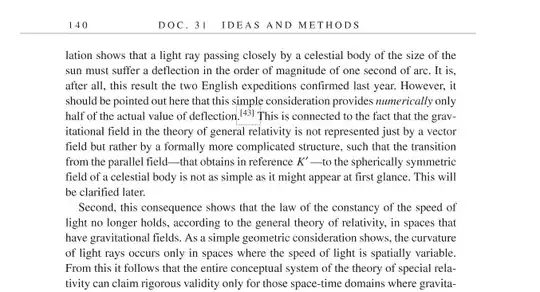
It would keep accelerating, but there's a problem. See what Einstein said in the second paragraph about the speed of light being spatially variable:

enter image description here

The "coordinate" speed of light decreases as the proton approaches the object - let's say it's a black hole. However falling objects do not slow down. They accelerate towards the gravitating body, and they do this because the of light is spatially variable. There comes a point when the falling body would be falling faster than the coordinate speed of light at that location, whereupon IMHO something bad has to happen. Friedwardt Winterberg talked about this sort of thing in his 2001 paper Gamma Ray Bursters and Lorentzian Relativity. This is the original black hole firewall, and I cannot explain why the general idea is wrong. So I have to say this: I think your proton disintegrates into gamma radiation on the way into the black hole.

Maybe somebody else here can explain why this is wrong, but I've asked around about it, and haven't had such an explanation so far. And if it's right, it means Exploring Black Holes by Taylor and Wheeler which John Rennie referred to in the other question, is wrong. Scary. NB: the force of gravity is 9.8m/s² at the Earth's surface, and it reduces with distance as per the plot of gravitational potential on Wikipedia.

John Duffield
  • 11,381