22

Mine line of thoughts goes like this:

  1. A propeller is effectively pushing itself away from molecules of air.
  2. The best any propeller can do is to create total vacuum in the front of itself.
  3. The maximum suction pressure of vacuum you can get is equal to the opposite of the atmospheric pressure around, right?
  4. The speed of the air flowing into the vacuumed space in front of the propeller is equal to the speed of sound.

Obviously we are extrapolating the friction of the body of the airplane etc. Is my line of thoughts at least partially plausible?

6 Answers6

28

Don't forget that the aeroplane will be moving forward, so it's not relying on a vacuum filling ahead of the propellor to supply the latter with air.

Now I daresay there are good engineering reasons why propellors are not efficient and even impracticable for supersonic flight, but I don't think there is a fundamental physics theoretical reason ruling them out.

A propellor, from a theoretical standpoint, is not greatly different from a gas turbine jet or even a rocket insofar that it is simply "throwing stuff backwards", thus thrusting off the air it throws and being pushed forward by dint of Newton's third law. If it can be supplied enough air to throw backwards (and I think my first sentence shows there is probably no shortage of supply) and if it can impart a high enough impulse to the air, then there is no in principle limit to how fast the air is thrown backwards by the propellor. What happens if it is thrown backwards at faster than the speed of sound? Well in this case there would be an overpressure, meaning there would be a buildup of air there, the air thus becomes denser and "stiffer", and the local speed of sound behind the propellor can thus be much higher that that of the surrounding air. As the propellor does this, the air will undergo a sharp adiabatic temperature rise. Carrying this idea to its logical extreme, observe that rocket engines throw gas out behind them at roughly 10 times the speed of sound. It's simply a matter of how much you accelerate the gas - in principle there's no difference whether this acceleration is achieved by chemical energy or a great big bat whacking the air backwards.

Selene Routley
  • 90,184
  • 7
  • 198
  • 428
18

Not physically, but practically there are (currently) better alternatives.

The limiting issue with propellers is similar to the limiting issue with helicopters: propellers work like wing sections in that they must accelerate flow to work; when you're near the speed of sound, this means you are going to cause shocks to form, and this issue is particularly bad (compared to a turbofan for example) as propellers work by accelerating a large mass of flow by a little, which means you make your propellers very large, and by extension, the length of your shock increases; shocks damage everything and they also require a vast quantity of energy to overcome - aerodynamicists like to avoid shocks.

Edit: The missing piece of information here is that whilst many people understand that, in a 1D tube, flow accelerates as cross sectional area decreases, up to M=1 (conservation of mass) - what is less well known is that as the cross sectional area then increases, the flow can continue to accelerate to M>1. This is the result of compressibility, amongst other things. Because of this there is no physical limit (insert some hand waving here, one certainly exists it's just not applicable in this region) we cannot exceed when accelerating our flow with a wing section e.g. a prop. The thing is that as we always slowly lose energy from our flow, at some point a supersonic flow will always return to subsonic conditions, which happens with a violent strong shock, across which an awful lot of energy is converted from K.E to heat.

As a result of improving understanding in this area, expect transonic aircraft in the next few decades to transition to turboprop designs with counter-rotating props.

4

A propeller can work at supersonic speeds because as it approaches those speeds it is catching up with the air molecules as it moves. So you don't have to "wait" for the molecules to move into the vacuum you create.

In other words the thrust of a propeller does not go to zero just because the plane reaches a certain speed.

But it is not enough to have thrust. You need "lots of" thrust...

Floris
  • 119,981
1

Your question, the way it is put, allows one fast answer: No, in principle, this airplane can fall with higher velocity then 1M.

However - what only you need is to accelerate the air molecules around so that you gain momentum (and speed). (1) In principle, it is not forbidden to invent such a propeller. But normally, with a classical design, you will have serious difficulties with efficiency at high rotation speeds.

Concerning the view (2,3), you should regard the propeller blades as wing-profiles, then you can play with dynamic pressure up and down. But you forget, that you have not only low pressure in front, but also a higher pressure behind.

(4) Basically yes, but the speed of sound depends on absolute temperature.

jaromrax
  • 1,994
1

The answer to the main question is no. The reason it is no, is because your reasoning is flawed. In addition to the vacuum created in front of the propeller, there is the impulse applied to the propeller by the reaction to the air being pushed away from the propeller. Although the force due to the vacuum reaches a limit, the one due to the impulse does not. It is limited only by how fast can the air be "pushed" backwards by the propeller, without the propeller breaking up. So, with a very high strength propeller and powerful motor, it should indeed be possible to fly at greater than M1.

Guill
  • 2,573
0

Yes the speed of a propeller driven aircraft is limited by the speed of sound, but not in the way you think. What's happening:

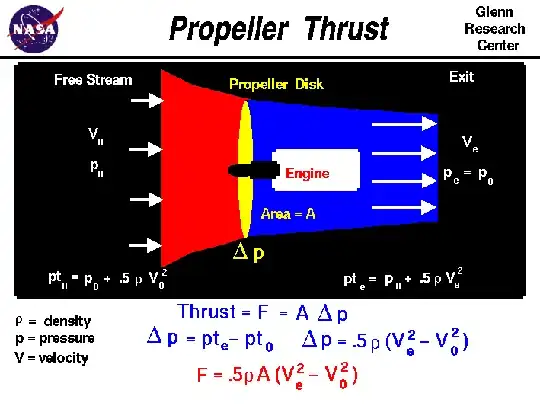
The propeller aircraft has a speed of its own and flies into a bunch of previously unsuspecting air, which was twiddling its thumbs. At subsonic aircraft speeds, the air in front of the plane gets a warning, and starts to assemble itself towards the propellor.
enter image description here

Image source

The incoming air hits the propeller disc at a higher total pressure than ambient pressure - no vacuum here! And the propeller imparts energy onto the incoming air stream, and accelerates it backwards. This provides the thrust that enables the aircraft to fly.

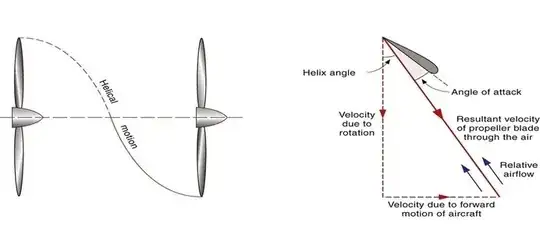
The picture above explains the principle of thrust generation using the momentum method, which is useful but does not concern itself with the power required to turn the propeller. The propeller blades are miniature wings spinning around, providing thrust (similar to lift in a wing) and requiring torque (similar to drag in a wing). The blade tip speed is the vector sum of rotational velocity and airspeed.
enter image description here

And if the tip speed becomes supersonic, that is where the limiting factor is. At supersonic speed, the shock waves produce an extraordinary amount of drag without any useful increase in lift whatsoever, so a rapid increase in required engine power without the propeller producing more thrust.

Note that the limiting speed is the propeller tip speed. The aircraft air speed is one of the vectors contributing to this, and is therefore always lower than the speed of sound. Practical limits for propeller aircraft are around M=0.6, above which jet engines are required.

Koyovis
  • 327