3

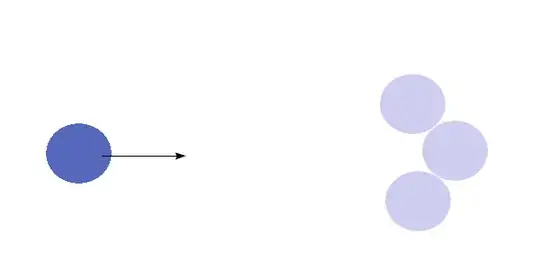
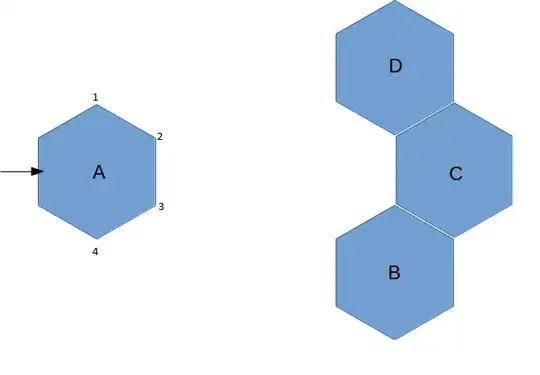
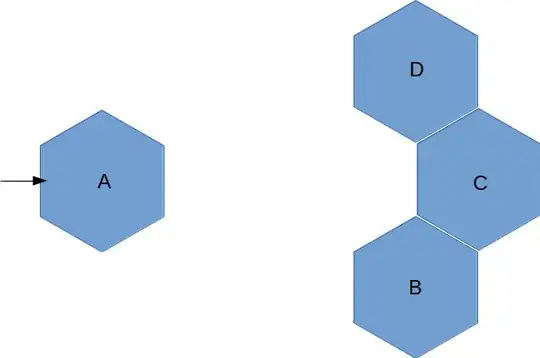
I'm writing a computer program/game and can't figure something out; I want to be able to calculate the resulting velocities of 4 particles (hexagons, specifically) after they simultaneously (elastically) collide, given their initial velocities. They all have the same size and mass, and in the specific case I'm trying to solve currently, one hexagon is fired at three stationary hexagons (as shown below).

I've seen many many problems on here and other sites dealing with the collision of 2 or 3 objects simultaneously, but none dealing with 4. Is it solvable? I've tried to solve it through looking at the forces, as well as through conservation of momentum/energy, but I can only ever get 3 equations, and there are 4 unknowns. Am I missing something?

I read something suggesting that many simultaneous collisions could be simplified by pretending they weren't actually simultaneous, and I'm looking into that, but I would like to better understand how this stated problem can be solved, or why it can't be solved if that ends up being the case.

Edit: I just wanted to update that this can't be simplified by pretending it isn't simultaneous,

Edit after being answered: In case anyone else is trying to do something similar, two solutions were given, the accepted answer solves the general case, while another answer below solves the specific case I asked about.

enter image description here

4 Answers4

7

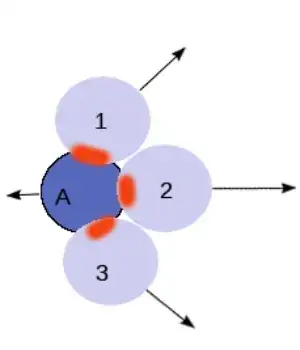
The problem is equivalent to 4 spheres colliding simultaneously, where top sphere center is at $60^o$ relative to the $x'x$ axes (same goes for bottom sphere):

enter image description here

We'll name them: sphere A (dark blue), and spheres 1, 2, and 3.

During the collision the spheres will behave like springs with an infinite hook constant. The forces on the spheres will be infinite and the duration of interaction will be 0.

collision

The red area is where the spheres are compressed during the collision. If sphere 2 is compressed by $l$, and spheres 1 and 3 by $d$, then $\frac{d}{l}=sin30^o$ (trigonometry involved but i couldn't draw it here) and finally $l=2d$.

The energy stored in each spring is given by the formula $U=\frac{1}{2}kx^2$, and it will be converted to kinetic energy. Therefor, $K_1=K_3=\frac{1}{4}K_2$ and $v_1=v_3=\frac{1}{2}v_2$.


Before the collision sphere A has velocity $v_A$ and after the collision, $v_B$.

Conservation of energy:
$K_A = \frac{1}{2}mv_A^2 = \frac{1}{2}m(v_B^2+v_1^2+v_2^2+v_3^2)$, that is $v_A^2=v_B^2+v_1^2+v_2^2+v_3^2=v_B^2+\frac{3}{2}v_2^2$ (1)

Conservation of momentum:
$mv_A=mv_B+mv_1+mv_2+mv_3$, that is, $v_A=v_B+v_{1x}+v_2+v_{3x}$

Momentum on y axes is 0, since $v_{1y}=v_{3y}$. Also, $v_1$ forms a $60^o$ angle, so $v_{1x}=\frac{1}{2}v_1=\frac{1}{4}v_2$ and

$v_B=v_A-\frac{3}{2}v_2$ (2)

Finally:
Using (1) and (2) we get a single solution $v_2=0.8v_A$. The other velocities can be easily calculated, since we have found $v_2$.

user
  • 1,270
3

Here is how you deal this this problem as a system of equations. For each contact pair assign a normal direction $\hat{n}_k$ and and impulse $J_k$. The possible contacts are AB, AC, and AD. We can introduce symmetries and simplifications later.

The initial velocity if body A is $v_A$ along the horizontal axis, and after the collision it is $v_A + \Delta v_A$. From the change in momentum you can work out

$$ m \Delta v_A = -J_{AB} \frac{1}{2} -J_{AC} - J_{AD} \frac{1}{2} $$

where the factors of 1/2 come from $\cos 60°$. This is simplification of the general equation $$m_i \Delta \vec{v}_i = \sum_k \hat{n}_k J_k$$ when projected along the x-axis.

Now we look at the momentum change of body C along the horizontal axis also

$$ m \Delta v_C = J_{AC} $$ and the momentum change for the rest of the bodies is measured along the contact normals (60° from horizontal) as $$m \Delta v_B = J_{AB} \\ m \Delta v_D = J_{AD}$$.

For fun I am including the possibility of inelastic collision with $\epsilon$ the coefficient of restitution. The collision rules are expressed along the contact normals where the final relative speed is a negative fraction of the impact relative speed

$$\begin{align} \frac{1}{2}(v_A+\Delta v_A)-(v_B+\Delta v_B) & = -\epsilon (\frac{1}{2}v_A-v_B) \\ (v_A+\Delta v_A)-(v_C+\Delta v_C) & = -\epsilon (v_A-v_C) \\ \frac{1}{2}(v_A+\Delta v_A)-(v_D+\Delta v_D) & = -\epsilon (\frac{1}{2}v_A-v_D) \end{align}$$

In the above three equations the changes of speed as substituted from the momentum equations such as $$\begin{align} \Delta v_A &= (-J_{AB} \frac{1}{2} -J_{AC} - J_{AD} \frac{1}{2})/m \\ \Delta v_B &= J_{AB}/m \\ \Delta v_C &= J_{AC}/m \\ \Delta v_D &= J_{AD}/m \end{align} $$

The above becomes a 3×3 system of equations for the impulses

$$ \frac{1}{m} \begin{bmatrix} -\frac{5}{4} & -\frac{1}{2} & -\frac{1}{4} \\ -\frac{1}{2} & -2 & -\frac{1}{2} \\ -\frac{1}{4} & -\frac{1}{2} & \frac{-5}{4} \end{bmatrix} \begin{pmatrix} J_{AB} \\ J_{AC} \\ J_{AD} \end{pmatrix} = -(\epsilon+1) \begin{pmatrix} \frac{1}{2}v_A-v_B \\ v_A-v_C \\ \frac{1}{2} v_A - v_D \end{pmatrix}$$

When B, C and D are at rest initially the above is solved for

$$ \begin{align} J_{AB} &= (\epsilon+1) \frac{m v_A}{5} \\ J_{AC} & = (\epsilon+1) \frac{2 m v_A}{5} \\ J_{AD} &= (\epsilon+1) \frac{m v_A}{5} \end{align} $$

Now the final velocities are found by $$\begin{align} v_A+\Delta v_A & = \frac{v_A (2-3\epsilon)}{5}\\ v_B+\Delta v_B &= \frac{v_A (\epsilon+1)}{5} \\ v_C+\Delta v_C &= \frac{2 v_A (\epsilon+1)}{5} \\ v_D+\Delta v_D &= \frac{v_A (\epsilon+1)}{5} \end{align}$$

For an elastic collision ($\epsilon=1$) the final speed of B is $v_B+\Delta v_B = 0.8 v_A$.

NOTE: Solution of n-body collision https://physics.stackexchange.com/a/91069/392
John Alexiou
  • 40,139
2

Its pretty much solvable.

enter image description here

Lets name the sides of the Hexagon in the order 1,2,3,4. When the hexagon A collides with B,C,D the 2-3 side collide with C and C moves in a direction of A and it will not effect all the other hexagons. Same way the side 1-2 will collide with D and give it motion in a direction perpendicular to side 1-2 and same for side 3-4... And we see due to symmetry the magnitude of velocity of hexagon D and B will be same.Breaking them in 2 component, one in the direction of A and other perpendicular to A. We will be able to solve for all the hexagons.

P.S.Can't make a good picture with description because of lack of Photoediting skills

Kishan Kumar
  • 271
  • 2
  • 9
1

The problem is ambiguous and has infinite solutions. The reason is that now you cannot ignore the relative forces between the A and B,C and D. For instance, if you solve the problem as non simultaneous collisions you will get a different answer depending on the order of the collisions. Suppose that A collides first with C, then A will stop, C will move at the initial speed of A, and B and D will remain at rest. If you instead make A collide with D and B first you will reach a different solution. In the real case of simultaneous collision for the 4 objects, you really need to also add as additional condition the relative forces between AB AC and AD (which is equivalent to freely chose one of the independent unknowns)

UPDATE: I played a little with the equations, and found (too large to type here) that the actual solution is a function of both the initial momentum of A and the amount of time during which the objects interact. Once you have that you can compute the normal forces between hexagons and then the relation between the momentum's transferred to them. I will leave that as an exercise to you.