53

The sources I've read compare gravitational waves to electromagnetic waves. I'm curious to what extent this is. In theory, could gravity be harnessed in similar ways to how we've used electromagnetic radiation such as in lasers?

If so: what differences would this have to a regular laser?

If not: What differentiates gravitational waves from electromagnetic waves to make this theoretically impossible?

John Rennie
  • 367,598

8 Answers8

29

Laser light generation is intimately related to processes that generate single photons. To date, gravitational waves have not been detected, and there are no known processes that produce single gravitons (not to mention there is no direct evidence that the gravitational field is quantized at all -- just logical arguments based on the structure of general relativity and quantum mechanics extrapolated to the relevant regime).

Since there aren't any processes known to produce single gravitons, there is no known means by which one could produce a gravitational wave laser.

EDIT: I agree with anna v's answer and John Rennie's comment, and I hadn't thought about free electron lasers when I wrote this. It would take relativistic planets or something like that, but it wouldn't be impossible.

14

I thought the answers that there can be no stimulated emission from excited gravitational states are correct, as there are no discrete bound states with the gravitational potential,but while exploring the suggestion by John whether one could make a free gravity laser in analogy to a free electron laser I found the following :

QUANTUM STATES OF NEUTRONS IN THE EARTH’S GRAVITATIONAL FIELD: STATE OF THE ART, APPLICATIONS, PERSPECTIVES

If one goes through the article, it is not a simple matter. A bound state of a neutron with the whole earth is not something one can build an inverted population with to create a laser. So the no should be qualified: beings who could experiment with ensembles of earths might be able to create inverted populations.

Now going to the gravitational analogue of a free electron laser I think we would have the same problem. The gravitational constant is very small, and it is necessary to use a neutral candidate so that the effect would not be masked by the electromagnetic changes, that one cannot see how an undulator with gravitational forces only could be attempted.
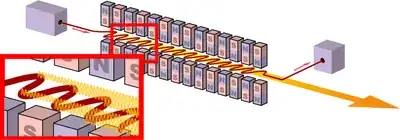
undulator

Schematic representation of an undulator, at the core of a free-electron laser.

The schema, because of the changes in acceleration might radiate coherent gravitational waves even as it is working with the charged electrons but due to the smallness of the gravitational constant these would be very weak , and , in my opinion , undetectable.

Of course all of the above with the assumption that gravity is quantized in the same way as the other three forces.

anna v
  • 236,935
9

The key to making lasers work is the concept of "stimulated emission". When you have a population inversion - a larger number of atoms / molecules in an excited state than in the corresponding ground state - you can tap into their energy by stimulation emission. When such an atom/molecule is excited with a photon with energy corresponding to the transition, it emits a photon that is perfectly in phase with the incident photon.

In this way you get two photons that are in phase, and traveling in the same direction. This mechanism results in a beautiful amplification, and a coherent beam of light.

There is no analog (that I can think of) for stimulated emission of gravitational waves - and so a GASER (gravity amplification by stimulated emission of radiation) is fundamentally impossible AFAIK. Fundamentally, a massive system (potential emitter of gravitational waves) cannot be in an "excited" state from which emission is possible by excitation with another gravitational wave.

Floris
  • 119,981
7

The physical principle behind the laser is stimulated emission. This is the easy part. There is a close analog of stimulated emission in general relativity, a phenomenon known as Superradiance. In short terms if you have a rotating black hole and emit gravitational waves in it with the right parameters you can get more gravitational waves out. The black hole loses angular momentum to feed the energy necessary to produce the amplification of gravitational waves. This is just the wave counterpart of a Penrose process. In a very heuristical point of view superradiance in a black hole is to stimulated emission as Hawking radiation is to spontaneous emission. Besides black holes superradiance has been theorized to occur also for rapidly rotating neutron stars.

So it is theoretically known that there are gravitational systems which do exhibit amplification of gravitational waves, without relying on population inversion or such things.

But a laser is not only amplification of waves, it is a device that operates with this mechanism in a stable way to produce coherent light. And this is where theoretically the "gravitational laser" dies. In a conventional laser one needs a cavity that a) provides a feedback mechanism so the device is stable (i.e. does not stop working because the population goes to ground state) and b) selects a given wavelength to produce the coherent light. And, as is well known, since gravity couples to everything there is no such thing as a gravitational cavity, or a mirror for gravitational waves.

In summary, it should be possible to produce gravitational waves of desired frequency, and is is possible to amplify the waves, the problem is that you cannot build a stable device. This covers the usual architecture of lasers, although it cannot rule out the free electron laser design, since it dispenses with a cavity. The issue would be to design the equivalent of a quadrupole wiggler, of which I have no idea how would work, but it doesn't seem to be theoretically ruled out

cesaruliana
  • 2,724
  • 13
  • 24
4

The only thing I can imagine can work in theory, is by exploiting the mixing of gravitons and photons in an external electromagnetic field, see here. You then produce ordinary laser light and this gets partially converted to coherent gravitational radiation. This is analogous to the Primakoff effect where photons could be converted to hypothetical axions in an external field. So-called "light shining through walls experiments" are being performed, where experimentalists let laserlight move through a strong magnetic field, shine that onto a wall, and then attempt to detect axions on the other side of the wall by applying a strong magnetic field which would convert the axions back to photons. One then exploits the fact that these photons would be in precise coherence with the laserlight on the other side of the wall to set strong limits on the properties of axions.

Count Iblis
  • 10,396
  • 1
  • 25
  • 49
0

If not: What differentiates gravitational waves from electromagnetic waves to make this theoretically impossible?

Electromagnetic waves couple to charge whereas gravitation waves couple to mass. Thus the process for generating gravitational wave would have to be very different from the standard Stimulated Emission/Population Inversion process used in a conventional laser.

hft
  • 27,235
0

As far as my understanding of physics go,the waves of gravity are like electromagnetic waves. The place where this idea falls apart is how these waves are made.

EM waves, especially those generated in lasers, are made by electrons absorbing/losing energy. There is no analog for gravity waves. Since lasers require EM waves being emitted (mostly) in sync with existing waves, and you cannot do that with gravity, you cannot have gravity lasers.

PipperChip
  • 2,238
-1

There's no known way to make a gravity wave mirror. The ability to do that would suggest something like Cavorite, aka unobtainium