41

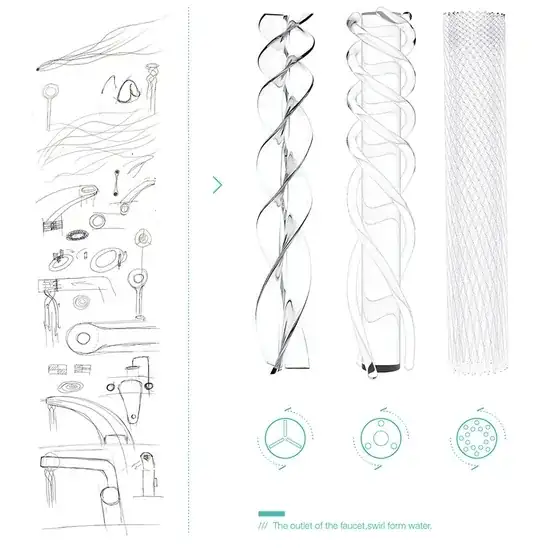
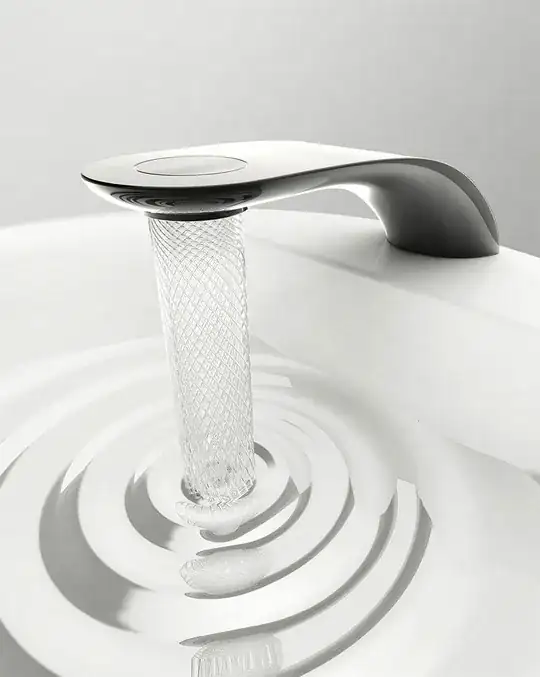
The faucet design depicted below is driving me crazy. The water falling from the tap appears to follow a spiral path. No one seems to agree whether it is physically possible for the water to spin in such a way. Is it possible? Please explain your answer. More info about the tap is available here.

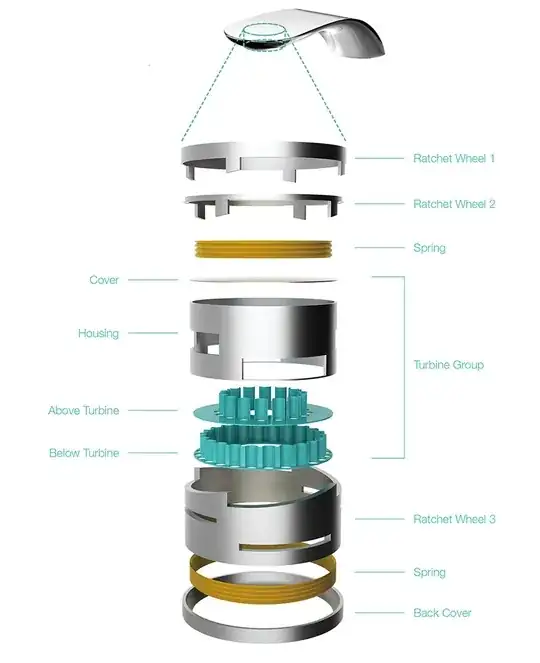
The faucet's overall design The faucet's components Sketches of the faucet

innisfree
  • 15,425

4 Answers4

59

You are right that, without a force acting on it, water falling from a tap could not follow a spiralled path. The tap, however, creates an illusion - the water appears to be spiralling, but it isn't - it's falling straight down.

The illusion is created by the "turbine" inside the nozzle, which rotates the ring of spouts that the water falls through. The effect is that a corkscrew shape of water falls downwards.

A falling corkscrew, however, is difficult to distinguish from a rotating corkscrew, hence the illusion,

Let me also add a caveat, pointed out by @Adam Davis. The pictures of the tap are all computer rendered. This fancy tap is just an idea - the designer has not built a working, proof of concept prototype. There might be serious difficulties in realizing such a design, for example, turbulence from the spinning nozzle might destroy the corkscrew shape of the falling water.

innisfree
  • 15,425
9

@innisfree's answer covers the tap in question, but I'd like to expand briefly. Like he says in his answer,

without a force acting on it, water falling rom a tap could not follow a spiralled path

Well, what if you do apply a force? Then yes, you can make water fall in a spiral.

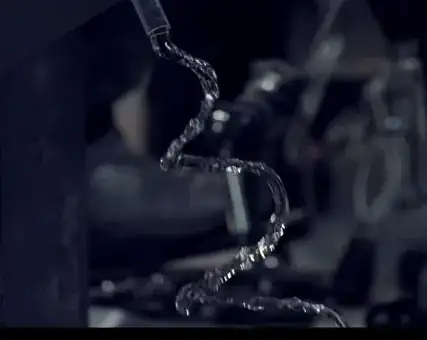
enter image description here

This picture is from a video I found while researching Chladni Plates. Essentially, nodes in sound waves can be visualized in different media when you apply that sound to the media. In chladni plates, you end up with simple two dimensional images for the nodes. The same principles can be applied to different media.
In this case, a bass drum is attached to a barrel of water which is slowly draining. The sound vibrates at a specific frequency, which can be seen in the spiral of the water.

jkeuhlen
  • 1,217
6

This probably won't work in practice at all.

First, there is the problem of Rayleigh instability that splits streams into droplets. It is true, that the more laminar the flow is, the more stable the stream. But in this case, the mechanism in the turbine will disturb the water rather than make it laminar, so the streams won't keep together in nice strings.

Also, the nozzle needs to be such, that the velocity of water is perfectly vertical, only the nozzle moves. If the water gets sideways momentum, the spiral will open up (you can call it centrifugal force effect if you want). But it's hard to engineer a nozzle that will rotate but won't push the water stream sideways in the process.

So in short: such a tap will probably make some kind of a spiral, but it will flow outwards and spray droplets around.

EDIT: There are a lot of art installations that use illusions like this one, but they don't move the nozzles: they just close and open the nozzles in a sequence like a printer. The pattern is made of droplets, not streams. Example: https://www.youtube.com/watch?v=gusJeslMbLc&html5=1

orion
  • 6,684
  • 23
  • 29
1

It would be possible, and not even terribly difficult, to have a faucet whose stream, viewed at a moment in time, would appear as a spiral. A double-spiral diamond pattern would be harder, but should by no means be impossible, though unless the diamonds were rather coarse they would tend to become blobby as water moved away from the faucet. The key observation, though, would be that all of the water in the stream would be moving in the same direction away from the faucet.

To understand what's going on, imagine that the pipe leading up to the end of the faucet was perfectly straight for the last six feet and one had a dowel in it. Imagine further that the end of faucet contained cutters around the perimeter which rotated as the dowel moved through. Even though the dowel wasn't rotating, the cutter would have no difficulty cutting a spiral groove in it (and a pair of counter-rotating cutter rings could cut a diamond double-spiral arrangement). Cutting neat-looking diamonds in water would be harder than with a solid dowel, but there are ways such a thing could be accomplished.

What's important to note, however, is that unless one is either taking a short-exposure photograph of the stream or illuminating it with a strobe light, it would appear as an ordinary stream of water. Stroboscopic illumination, however, could make the pattern appear to move slowly upward or downward along the stream (there would be a limit to how fast the pattern could appear to move and still be visible as a pattern). The strobe wouldn't change the rate at which the water actually moved, however--merely how the pattern within the water would appear to move.
supercat
  • 709