4

Often read that until Hawking the black holes were introducing a problem with information. Allegedly information should be unable disappear, while this was happening in classic black holes.

What about death? When information, contained in brain or device, just irreversible dissipate in the environment and become lost.

Is this treated as information disappear?

There are thermodynamics law stating that energy tends to dissipate irreversible. Is the same law exists for information?

If "yes" then what is the difference between irreversibility of information loss and disappearance of information in pre-Hawking black hole?

Dims
  • 1,752
  • 14
  • 27

2 Answers2

7

If you drop an egg then it looks as though the process is irreversible and that the information about the original state of the egg is lost. However this isn't the case. The equations describing how the egg shatters are all time reversible so in principle, if not in practice, we could take the shattered egg and evolve time backwards to reconstruct it.

Likewise, when your dead brain decays all the processes involved are in principle time reversible. We could measure the state of your decomposed corpse and evolve time backwards to calculate the configuration of your brain (and therefore presumably the information it in) just before your death.

In both these cases information is not lost, it is just dispersed into the environment. For all practical purposes the information is lost, since there is no realistic way of recovering it, but in principle the information is still out there.

The problem Hawking described is quite different. Hawking's claim was that if we measure the radiation from an evaporating black hole then even in principle there is no way to evolve time backwards to discover the configuration of matter before it fell through the event horizon. In this case information is genuinely lost - even some hypothetical physicist with god like powers could never recover it.

As far as I know there is still no consensus about the resolution of the problem.

John Rennie
  • 367,598
5

If I recall it correctly, the information sunk into black hole can be considered encoded in the ripples on black hole surface, much like egg impact parameters which could in principle be deciphered (at least partially; even quantum theories give us certain confidence intervals) from shattered egg fragments. Falling objects will necessarily have mass, and therefore they'll create perturbations in the gravitation field of the black hole and correspondingly will contribute subtle deformations to the shape of the event horizon.

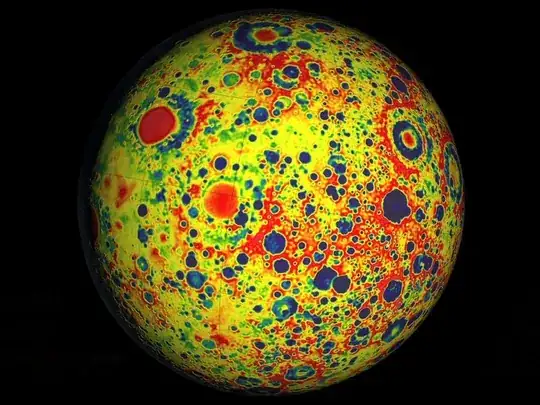
Recall that geoid gravity field isn't exactly a gravity field of a sphere (and this is quite a practical issue), or recall lunar gravity maps from the NASA GRAIL mission: on closer study, they actually look quite detailed and immediately display a lot of historical information

GRAIL lunar map

In principle, how much information can the gravity field store? It seems that black hole gravity field is detailed enough for all of information of its contents. I guess that was the bet lost by Hawking.


Also, my personal favorite is the so-called "Szilard's engine" which is pretty amusing and gave me a lot of insight into information-theoretical thermodynamics. It's a thought experiment resembling the Maxwell's Daemon which, in one of interpretations, is able to convert 1 bit of information into $k_B T \cdot ln (2)$ joules of work.

ulidtko
  • 201