2

I have read that during fission and fusion processes, there is some kind of equilibrium between the single nucleus and the disintegration products, so they are constantly being converted into each other. Furthermore, the energy after the fission of a single parent nucleus into two daughter nuclei is less than the energy required to fuse the two nuclei back together again.

So if there is an equilibrium, how is the fusion energy achieved? Where did the extra energy come from?

Qmechanic
  • 220,844

3 Answers3

2

I am replying to this because you seem to be a student, and not so clear on the statements.

I have read that during fission and fusion processes, there is some kind of equilibrium between the single nucleus and the disintegration products, so they are constantly being converted into each other.

" I have heard" is not enough, you should give a quote or a link. The statement is wrong. During fission a large nucleus breaks up because its component parts are more stable and the total energy balance is positive.

Look at this binding energy per nucleon in a nucleus curve:
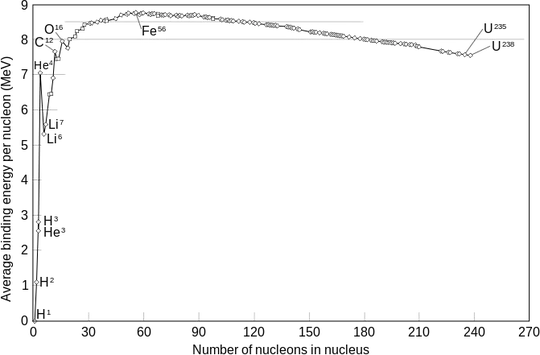
nuclear binding energy curve

Below the top of the curve, putting together more nucleons gives energy, from the top of the curve to the right, removing a nucleon releases energy.

Furthermore, the energy after the fission of a single parent nucleus into two daughter nuclei is less than the energy required to fuse the two nuclei back together again.

This also is an out of context quote, you should give a link. According to the binding energy curve per nucleon it is a wrong statement

So if there is an equilibrium, how is the fusion energy achieved?

There is no equilibrium in laboratory conditions. Even in the center of the sun, more nuclei fuse than separate, otherwise the sun would non be the source of energy it is.

The fusion energy is released because two deuteron particles tied into one nucleus will have to release energy, as seen in the binding energy curve.

The fission energy happens because heavy nuclei are metastable in the sense that they could be pushed to break up into smaller parts more tightly bound releasing the binding energy of the large system.

Where did the extra energy come from?

The extra energy for fusion comes from the original existence of hydrogen helium atoms. This happened during the Big Bang, according to the present model of creation of the universe. Atoms up to Fe in the binding energy curve were created in nucleosynthesis time. The heavier atoms were given energy by large explosions of heavy stars, like supernovae explosions, during the early universe days. All matter as we see it now was given its energy content at those early times , from the original impulse that generated the Big Bang.

anna v
  • 236,935
0

There isn't normally any equilibrium.

In fusion/fission reactions, the mass of the products is less than the mass of the reactants, this lost mass has been converted into energy. Because of the fact that mass can be converted into energy (as described by $ E=m c^2 $), we often think of mass as a form of energy, in which case energy in these reactions has been conserved.

-3

The law of conservation will always hold. The Fist Law of Thermodynamics: The increase in internal energy of a closed system is equal to the difference of the heat supplied to the system and the work done by it: ΔU = Q - W Law of Conservation of Energy: The total amount of energy in any isolated system remains constant, and cannot be created or destroyed, although it may change forms. Meaning that if no energy is added or taken away, the energy will always remain constant. The only thing that will change will be the amount of entropy in a system. What is happening is energy is being taken from another source (AKA the nuclei). Energy can not be created nor destroyed. It can only change form. Energy will be stored in the atom both in the nucleus and the surrounding electrons. The atom itself will vibrate and move around because of the total energy it has stored. We measure its movement as heat. The faster it moves the hotter it is. Fusion is a pretty stable process (relatively speaking). It is what our sun uses. Fission is what is used in modern day nuclear reactors and atom bombs. When the atom splits the particles inside the nucleus decay. They "change form", speaking in in thermodynamics. The particles in the atom emit gamma rays (very high energy photons), a lot of kinetic energy and anti-neutrinos. Some neutrons will escape and become "free neutrons" before decaying to protons and beta particles.