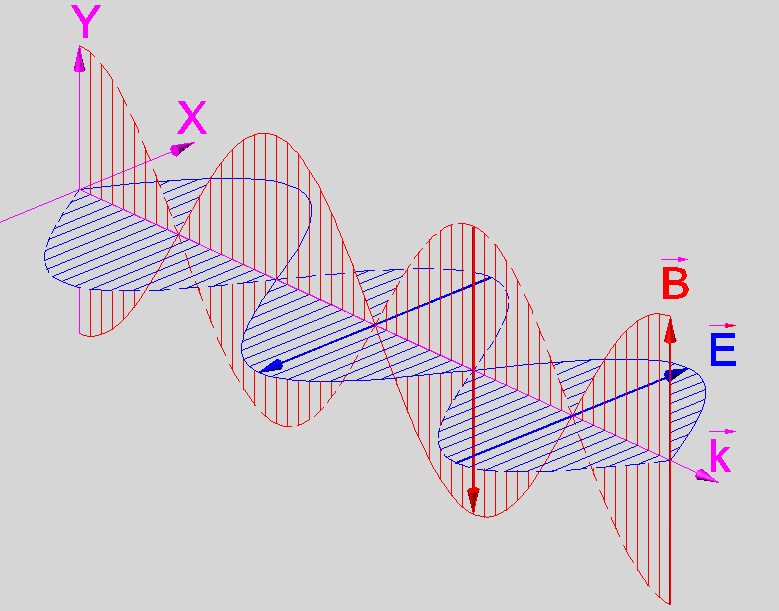
A light is made up of electric and magnetic fields oriented perpendicular to each other. Can polarization lead to the removal of any of the fields completely?
Asked
Active
Viewed 1,680 times


3 Answers
2
Light is the visible part of the electromagnetic radiation and consists of photons. Each photon has an oscillating electric and an oscillating magnetic field. In vacuum both fields are perpendicular to the direction of the photon's motion and perpendicular to each other too (see this sketch).
There are mainly two used by people opportunities to increase the emission of photons with energy supply: by heating or by accelerating electrons (electrically charged particles).
All bodies recieve and emit EM radiation constantly. The photons from the thermal radiation are not polarized, ie the electric and magnetic oscillations are randomly distributed.
The typical production of EM radiation by accelerated electrons happens in an antenna rod. A lot of electrons generate in this way a lot of photons. The electric and the magnetic component of the photons oscillate in unison and produce a summary EM field. The photons of these radio waves are polarized and - answering according to your question - no one of the components are lost.
In order to polarize photons from heating sources you send it through a polarizing filter. In this case, a part of the photons is converted into photons of lower frequency, a part is reflected and about 50% (for good filter) pass through the filter. They have always behind both EM components, but they are all oriented in the same direction.
To prove this, place a second polarizing filter behind the first, but rotated by an angle less than 90° to the first. Behind the second filter light is seen too. The polarized EM field was rotated by the filter, but no component was deleted.
To prove that rotation of the EEm field happens you could do the next. Rotate the second filter at 90 ° to the first filter. Well, no light is going through this filter system. If one place now another filter between the first and second filter (in an orientation between 0° and 90° to the other two filters), then the light goes through again. Ergo the EM field has been influenced and rotated by the polarizing filter. But again components of the EM field do not vanish.

HolgerFiedler
- 10,980
1
I think it is easier to think of, in the case of a linear polarizer, as it aligning all the electric fields to one axis. After the light goes through it the electric field is aligned to one particular axis and the magnetic field will be perpendicular to it.
The electric and magnetic field are required for the propagation of light. Essentially an oscillating magnetic field creates an electric field and vice versa. One can see this from Maxwell's equations that they solve the wave equation. So in the case of light you can not have the electric field without the magnetic field.

Peter Anderson
- 140
0
Not completely clear what you mean. You can't completely remove the electric or magnetic field - an electromagnetic wave needs both!
Light with no particular polarization can be thought of as an equal mixture of light with polarization at right angles to each other, but both in a plane that is perpendicular to the wave motion.
However, when you pass light through a (linear) polarizer then you would usually lose one of these perpendicular polarization states, leaving just one to pass through. If this is how your polarizer works then of course you lose half the power from your beam.
An example of this would be a wire grid polarizer, where the electric field parallel to the wires is reflected or used to accelerate electrons in the wires and dissipated in ohmic losses. Only the component of the E-field perpendicular to the wires is transmitted (along with its accompanying perpendicular magnetic field).