The "loop" might refer to the eddy current effect that large metal objects experience when moving into a changing magnetic field - current will flow to counter the change in flux. An excellent picture can be found [source]:
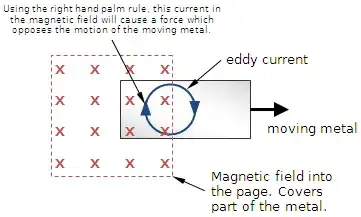
This effect can be quite spectacular: if you drop a strong magnet down a thick copper tube, it will almost appear to levitate, for example. This shows that with strong fields and rapid changes, the effect is very real.
But when you are flying near the South Pole there is very little change in flux, therefore no eddy currents. If there is any effect at all it would indeed be the net velocity of the electrons experiencing a force due to the (static) magnetic field.
You need to draw a careful picture to figure out if the force is pointing to the left or right - and recognize that an electron moving left means the highest potential is on the right. Also - the South Pole has field lines coming out of it (it is a "magnetic north pole"), but I assume you know that.
Incidentally, related to this is the Hall effect: in a Hall sensor, the velocity of the charge carriers is induced with a current, and a voltage is observed perpendicular to both the current and the magnetic field. What is fascinating is the fact that p-doped semiconductors will exhibit the opposite voltage from n-doped ones - positive charge moving one way or negative charge moving the other way experience a force towards the same side of the sensor, but result in opposite polarity of the signal. This is a beautiful demonstration of the fact that "holes" (which look like negative charge moving in the opposite direction) really are positive charges moving. Very unintuitive.


