1

Is there an equation that describes the Sun's emitted power on the surface [in $\frac{W}{m^2}$] over a selected wavelength range (from $\lambda_1$ to $\lambda_2$) ?

I am guessing this can be calculated using Planck's law, but I just can't find the right equation to integrate it and get the result.

EDIT:

http://www.wikiwand.com/en/Stefan%E2%80%93Boltzmann_law#/Derivation_from_Planck.27s_law

Could I integrate this equation from $\nu_1$ to $\nu_2$ intead of 0 to $\infty$:

$\frac{P}{A} = \frac{2 \pi h}{c^2} \int_0^\infty \frac{\nu^3}{ e^{\frac{h\nu}{kT}}-1} d\nu$

Like this:

$\frac{P}{A} = \frac{2 \pi h}{c^2} \int_{\nu_1}^{\nu_2} \frac{\nu^3}{ e^{\frac{h\nu}{kT}}-1} d\nu$

Where $\nu_1$ and $\nu_2$ are the frequencies of the light.

And then I would use Simpsons rule to numerically integrate and get the result?

And just a quick question, how inaccurate is Planck's law for the Sun at UV spectrum?

1 Answers1

2

The Planck function is tricky to integrate. I found the following http://ntrs.nasa.gov/archive/nasa/casi.ntrs.nasa.gov/19680008986.pdf might help. In particular, Appendix C contains numerical tables of integrals for the Planck function between some frequency $\nu$ and infinity. Obviously, by subtracting one of these results using $\nu_1$ and another using $\nu_2$ will give the integral between $\nu_1$ and $\nu_2$.

It also contains the (short) Fortran code to do the integrals yourself.

The flux at the solar surface is $\pi B_{\nu}$ in W m$^{-2}$ Hz$^{-1}$ using the appropriate temperature for the solar photosphere.

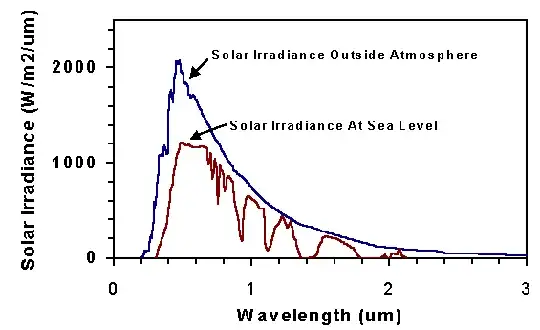
NB: The Sun is not a blackbody to any significant precision near the peak of the distribution and instead you should integrate a spectrophotometric solar atlas or possibly a synthetic spectrum generated from a model atmosphere that is appropriately tuned for the Sun. Many such models exist - e.g. http://kurucz.harvard.edu/sun.html It is probably reasonable to treat the Sun as a blackbody from the near infrared and at longer wavelengths.

Here's a rough sketch of the intrinsic solar spectrum (and one after it has passed through the Earth's atmosphere), that I found at http://www.crisp.nus.edu.sg/~research/tutorial/optical.htm and which clearly shows the non-blackbody nature of the spectrum below 1 micron (including in the UV region).

enter image description here

ProfRob
  • 141,325