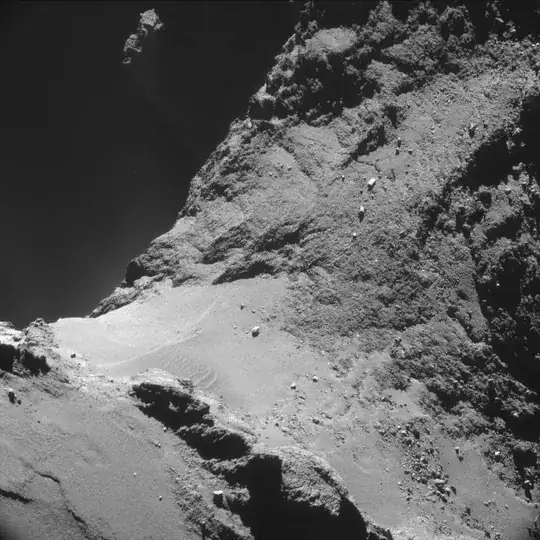
Wild unsubstantiated guess: Could it be flow of the sand down an incline, more like a glacier than sand dunes. Maybe the flow gets a boost from tidal forces flexing the comet whenever it passes near a massive body. Some of the patterns in the sand in the lower left corner look like what happens when sand slips down a critical incline like on an over ambitious sand castle. Of course it is hard to tell which way is actually down in this picture.
Did a little internet search. Comet 67P is kind of dumbell shaped. Seems like the valley we looking down into is the "neck" around the middle of the comet, so the may be no down on the valley floor where the dunes are.
However, being the thin neck between two massive bulges would make the valley floor extra prone to stresses from tidal forces acting differentially on the 2 bulges.
Could the dunes be the result of the core of the comet just flexing under the sand in place?
The patterns on the side of the valley in the lower left would be consistent with sandslides towards the valley floor.
Another possibility is that because of it's highly irregular shape, the rotation of 67P is chaotic like Hyeprion's. If that is the case then sands on the surface would experience tangential forces as the the rotation of the core changes direction. This could produce interesting patterns on the surface of the sands.
However, 67P's rotation looks regular in this video. The Wikipedia article does mention changes in rotation from "sublimation induced torque" though.
It is also possible that the gases the comet gives of when near the sun do flow along the surface. So the cause of the patterns could be more like earth dunes after all.