I have read in numerous places like here that an object in free fall into a black hole will be travelling the speed of light when it passes the event horizon. How is it possible to go this fast? Does it continue accelerating, faster than light until it is crushed by the singularity?
Asked
Active
Viewed 457 times


1 Answers
1
A material object may hit the (spacelike) singularity (like one inside the Schwarzschild black hole) at any speed smaller than $c$, if measured from the frame in which the singularity itself is described by $t={\rm const}$. In other words, the angle in the Penrose causal diagram between the incoming trajectory of the doomed massive object and the horizontal line of the singularity may be an arbitrary angle between $-\pi/4$ and $+\pi/4$. There is no other restriction on speeds.
The OP's main statement on the page behind the words "like here" is invalid. A massive object crossing the event horizon moves by a speed $v\lt c$ (locally) with respect to any local inertial frame. It cannot be otherwise. This statement in no way contradicts the fact that the escape speed from the black hole is really or formally $c$ (or larger). The reason why there is no contradiction is that there is absolutely no symmetry between the inward motion and the outward motion. The former is possible and maximally supported; the latter is classically prohibited.
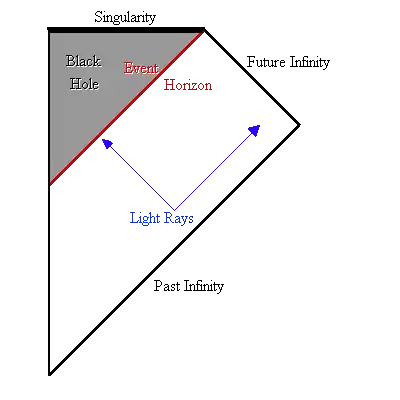
The time goes up, the bottom is the past and the top is the future. The grey region is the black hole interior. You see that it's very easy to get in but, because the restriction $v\lt c$, one can't get out.
The time-reverted (upside-down rotated) Penrose diagram would describe a "white hole". At the level of the microstates, the states describing a white hole would be the very same states as the black hole states, so one shouldn't double count them. However, only the evolution described by the black hole spacetime diagram is allowed (e.g. a black hole is swallowing matter, not spitting it out) because the "white hole spacetime diagrams" would violate the second law of thermodynamics (the entropy would macroscopically decrease which isn't allowed).

Luboš Motl
- 182,599