34

Why can't cables used for computer networking transfer data really fast, say at the speed of light?

I ask this because electricity travels at the speed of light. Take Ethernet cables for example, I looked them up on wikipedia.

Propagation speed   0.64        c

Why only 64% What does propagation speed mean? I know there are other variables affecting the latency and perceived speed of computer network connections, but surely this is a bottle neck.

In other words, I'm asking, what is it about a fiber-optics cable that makes it faster than an Ethernet cable?

lalit
  • 103
Celeritas
  • 451

8 Answers8

72

Since cables carry electricity moving at the speed of light, why aren't computer networks much faster?

Perhaps I can address your confusion with a rhetorical question:

Since air carries sound moving at the speed of sound, why can't I talk to you much faster?

The speed of sound is much slower than light, but at 340 m/s in air, it's still pretty damn fast. However, this isn't the speed of the channel, it is its latency. That is, if you are 340 meters away, you will hear me 1s after I make a sound. That says nothing about how fast I can communicate with you, which is limited by how effectively I can speak, and how well you can hear me.

If we are in a quiet room, I can probably speak very quickly and you can still hear me. If we are far apart or the environment is noisy, I will have to speak more slowly and clearly.

With electrical communications the situation is much the same. The speed limit is not due to the latency, but rather how fast one end can transmit with the other end still being able to reliably receive. This is limited by noise picked up from the environment and distortions introduced by the cable.

As it turns out, especially for long distances, it is easier (and more economical) to manufacture a fiber optic cable that does not permit outside interference and introduces very little distortion, and that is why fiber optic cables are preferred for long distance, high speed networking.

The reasons for optical fiber's superior properties are many, but a significant development is single-mode fiber. These are fibers which, through carefully controlled geometry and research clever enough to earn a Nobel prize, support electromagnetic propagation in just one mode. This significantly reduces modal dispersion, which has the undesirable effect of "smearing" or "spreading" pulses which encode information. This is a kind of distortion that if excessive, renders the received signal unintelligible, thus limiting the maximum rate at which information can be transmitted.

A further advantage is that fiber optic communications operate at an extremely high frequency, which reduces chromatic dispersion, a distortion due to different frequencies propagating at different speeds. Typical wavelengths used in fiber are in the neighborhood of 1550 nm, or a frequency of around 193000 GHz. By comparison, category 6a cable is specified only up to 0.5 GHz. Now, in order to transmit information we must modulate some aspect of the signal. A very simple modulation would be turning the transmitter on and off. However, these transitions mean the signal can not consist of just one frequency of light (Fourier components), so the different frequency components of the pulse will be subject to chromatic dispersion. As we increase the carrier frequency but hold the bitrate the same, the fractional bandwidth decreases. That is, the transitions from the modulation become slower relative to the carrier frequency. Thus, chromatic dispersion is decreased, since the signal becomes more like just one frequency of light.

Modern single-mode fiber is so good that the information rate is usually limited by our technology to manufacture the receivers and transmitters at the ends, not by the cable. As an example, wavelength-division multiplexing was developed (and is constantly improved even today) to allow multiple channels to coexist on the same fiber. Several times, networks have been upgraded by upgrading the transceivers at the ends, leaving the cable unchanged. Considering the cost of upgrading a transcontinental cable, the economic advantage should be obvious.

Phil Frost
  • 4,241
29

As you've probably guessed the speed of light isn't the limitation. Photons in a vacuum travel at the speed of light ($c_o$). Photons in anything else travel slower, like in your cable ($0.64c_o$). The amount the speed is reduced by depends on the material by the permittivity.

Information itself is slower still. One photon doesn't carry much information. Information is typically encoded in the change of states of the energy. And these changes of states can only be propagated at lower rates than the fundamental transmission speed.

Detecting both the energy and the rates of change require physical materials to convert the photons into something more usable. This is because the channel used for transmission usually conducts energy at a maximum rate called bandwidth. The bandwidth of the channel is the first limit in network speeds. Fiber optics can transmit signals with high bandwidths with less loss than copper wires.

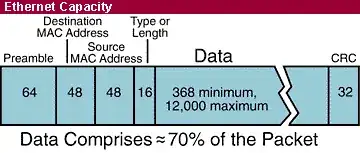
Secondly the encoded signals have a lot of overhead. There is a lot of extra data transmitted with error correction, routing information, encryption and other protocol data in addition to the raw data. This overhead also slows down data throughput.

ethernet

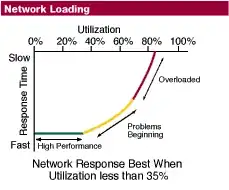
Lastly the amount of traffic on a network can slow down the overall system speed as data gets dropped, collisions occur and data has to be resent.

slowdown


EDIT: I see you've changed your question some....

In other words I'm asking, what is it about a fiber-optics cable that makes it faster than an Ethernet cable?

Fiber optics has the ability to conduct higher energy charges. Photons with higher energies, by definition are at higher frequencies.

$E_{photon}=hf$ where $h$ is the plank constant (h=6.63*10^-34 J.s) and $f$ is the frequency of the photon.

Why does frequency matter? Because of how communication systems work. Typically we setup a strong signal oscillating at the most efficient frequency for the transmission channel to conduct it. If the frequency is too low and we lose our signal's power and likewise too high and we lose power. This is due to how the medium responds to different levels of charge energy. So there's a $F_{max}$ and a $F_{min}$.

Then we add information to the oscillation by changing it at some rate. There are a many ways to add information but in general the amount of information you can add is proportional to the rate the channel can respond to or bandwidth of the system. Basically you have to stay in between $F_{max}$ and $F_{min}$.

It just so happens that the higher the operating frequency the easier it is to get wider and wider bandwidths. For example a radio at 1GHz with 10% channel width only allows for 100MHz max switching rates. But a fiber optic signal at 500THz a 10% channel width means a 50THz max switching rate. Big difference!

You might be wondering why channels have frequency limits and why 10%. I just picked 10% as a typical example. But transmission channels of all types have limits to what kind of energy levels they absorb, reflect, and conduct. For a rough example x-rays which are high frequency or high energy charges, they go right though a lot of materials, whereas heat which is a frequency lower than optical light doesn't transmit well through paper but it can through glass. So there are frequencies where photons can be used to carry energy and frequencies where they can't.

Yes they do all travel at $c_o$ in free space and slower in other media, but they can't carry information at that same rate or higher. You might be interested to read Shannon-Hartley's Theorem.

user6972
  • 5,808
12

A transmission line is made of a pair of conductors which have some resistance, inductance, capacitance, and leakage conductance. We can take all of these per unit length:

a cable

The wave equation for signals in this line, in the limit of a lossless cable with $R=0$, $G=0$, is $$ \frac{\partial^2 V(x)}{\partial x^2} + \omega^2 LC \cdot V(x) = 0 $$ You have to be a little careful with notation and dimensions here. In a typical circuit you use $L$ and $C$ for total inductance and capacitance, and $\sqrt{LC}$ is the characteristic frequency of the oscillator. Here, $L$ and $C$ are the inductance and capacitance per unit length, and so $1/\sqrt{LC}$ has units of speed.

In fact the derivation at wikipedia goes on to show that, in the limit of a lossless cable, the output is $$ V_\text{out}(x,t) \approx V_\text{in}(t-\sqrt{LC}x) $$ which is consistent with signals traveling down the cable with speed $v=1/\sqrt{LC}$.

Clearly the inductance and capacitance per unit length for a cable depends mostly on their geometry, and somewhat on the magnetic and dielectric properties of the space around and between the cables. It'd be interesting to come up with values of $L$ and $C$ that give $v=c$, or $v>c$; I haven't done this myself, but I suspect that geometric considerations alone will make this impossible for vacuum-separated parallel wires, coaxial wires, and other common geometries without introducing some magical meta-material.

rob
  • 96,301
5

"Surely this is a bottleneck" - No, it's really not. Any real-life network connection is not speed-limited by the propagation speed of the signal in the cable, but by the processing delays in the various routers, switches, and network interface processing at each end.

peterG
  • 405
3

How sure are you that electricity travels at the speed of light? Although electricity propagation moves at the speed of an E/M wave, and not electrons, its speed depends on the dielectric constant of the material. Only in a vacuum, I think, would it travel at the speed of light.

jhobbie
  • 629
3

Why only 64% What does propagation speed mean? I know there are other variables effecting the latency and perceived speed of computer network connections, but surely this is a bottle neck.

Speed of signal propagation is distance the signal (packet) travels in one second. It is usually lower than $c$ because EM waves that carry the information travel in metal or any material medium with lower velocity than $c$. See group velocity and theory of dispersion.

The speed of the signal determines minimum latency, but increasing it by changing medium or using different frequency band would have little effect on the maximum data rate of the transmission line (bits/s transferred). This is determined more by the electric power used for the transfer, intensity of noise and bandwidth used as well as capabilities of the electronics on the ends. Optical cables are used not for their faster signal propagation speed, but for their other benefits, such as much broader usable bandwidth.

3

Two reasons:

1) The speed of light in a "medium" is (almost*) always slower than the speed of light in a vacuum.

2) Electricity propagating in a wire is subject to inductive and capacitive effects which slow it's progress.

And even if wires were infinitely fast, integrated circuits are not. Again, inductive (a little) and capacitive (a lot) effects limit how rapidly an IC "gate" can "switch".

Interesting bit of trivia: The wires connecting points of the "backplane" of the (ca 1976) Cray 1 "supercomputer" were all the same length, whether the wire spanned an inch or 30 inches. This assured they had the same propagation delay.

(*) I vaguely recall that the lab guys have created weird scenarios where light propagates through certain special media "faster than light".

Hot Licks
  • 1,189
0

The speed of electrons that flows in the cable, i.e. the current, is only a few m/s. The EM wave propagates much faster. Anyway, the speed of a computer no depends intrinsically of the speed of electrons, but the speed of energy transfers between electronics components.

Martin Petrei
  • 599
  • 2
  • 8