5

The definition of the SI unit "second" is stated as

The second is the duration of 9 192 631 770 periods of the radiation corresponding to the transition between the two hyperfine levels of the ground state of the caesium 133 atom.

with the explicitly added note that

This definition refers to a caesium atom at rest at a temperature of 0 K. This note was intended to make it clear that the definition of the SI second is based on a caesium atom unperturbed by black body radiation, that is, in an environment whose thermodynamic temperature is 0 K. The frequencies of all primary frequency standards should therefore be corrected for the shift due to ambient radiation [...]

In referring to a caesium atom in its "ground state", does this definition pertain to caesium atoms that are plainly and exactly unperturbed, whether by black body (ambient) radiation or due to any known or unknown perturbation?

If so, is there any requirement to determine (and possibly correct for) the perturbation, or "shift", of any and all primary frequency standards, besides the described "shift due to ambient radiation"?

In particular, is there any requirement to measure whether the durations of 9 192 631 770 periods of different primary frequency standards and/or of the same primary frequency standard in different trials, had been and remained equal to each other, by (presumably) unambiguous means (such as the "ideal clocks" described in MTW §16.4) ?


EDIT
In response to comments, the following are excerpts of two relevant sections of MTW, "Gravitation":

Box 16.4: Ideal Rods and Clocks Built from Geodesic World Lines; Based on Marzke and Wheeler (1964)

Each geodesic clock is constructed and calibrated as follows:

(1) A timelike geodesic $\mathcal{ AC }$ (path of a freely falling particle) is passing through $\mathcal{ A }$.

(2) A neighboring world line, everywhere parallel to $\mathcal{ AC }$ [...] is constructed by the method of Schild's ladder (Box 10.2). [...]

(3) Light rays (null geodesics) bounce back and forth between these parallel world lines; each round trip constitutes one "tick". [...]

(4) The proper time lapse, $\tau_0$, between ticks is related [...] $s^2[~\mathcal{ AB }~] = -(N_1~\tau_0)~(N_2~\tau_0)$, where $N_1$ and $N_2$ are the number of ticks between events shown in the diagram.

$$~$$ $$\textbf{ <Insert MathJax source code for generating an appropriate diagram here>} .$$

Spacetime is filled with such geodesic clocks. Those that pass through $\mathcal{ A }$ are calibrated as above against the standard interval [...] and are used subsequently to calibrate any other clocks they meet.

Any interval [... $s^2[~\mathcal{ PQ }~]$ ... with event $\mathcal{ P }$] along the worldline of a geodesic clock can be measured by the same method [...]

To achieve a precision of measurement good to one part in $N$, where $N$ is some large number, take two precautions: [...]

The M-W construction makes no appeal whatsoever to rods and clocks of atomic constitution. [...]

Box 10.2: From Geodesics to Parallel Transport to Covariant Differentiation to Geodesics to ...

A. Transport any sufficiently short stretch of a curve $\mathcal{ AX }$ [...] parallel to itself along curve $\mathcal{ AB }$ to point $\mathcal{ B }$ as follows:

(1) Take some point $\mathcal{ M }$ along $\mathcal{ AB }$ close to $\mathcal{ A }$. Take geodesic $\mathcal{ XM }$ through $\mathcal{ X }$ and $\mathcal{ M }$.
[...] define a unique point $\mathcal{ N }$ [on geodesic $\mathcal{ XM }$] by the condition [...] "equal stretches of time in $\mathcal{ XN }$ and $\mathcal{ NM }$".

[...]

(4) Repeat process over and over [...] Call this procedure "Schild's Ladder" from Schild's (1970) similar construction [...].

user12262
  • 4,360

3 Answers3

3

is there any requirement to determine (and possibly correct for) the perturbation, or "shift", of any and all primary frequency standards, besides the described "shift due to ambient radiation"?

Yes. These are called "systematic errors" and they are the order of business pretty much all day, every day, at the metrology labs that implement frequency standards. This includes the effect of thermal radiation, called the blackbody radiation shift, as well as a number of other effects which can perturb the atoms. Chief among these are Zeeman shifts from stray magnetic fields in the lab, but you also get Stark shifts, light shifts, and a bunch of implementation-specific effects. If you're trapping your atoms in place, for instance, you need to account for any perturbations this might make to the ground state; if you're shooting them up in a fountain clock then you need to worry about things like gravitational redshift between the bottom and the top of the fountain.

The definition of the SI second is for caesium in its true, ideal ground state, with no perturbations whatsoever. This is obviously an idealization, and any implementation simply needs to estimate the accuracy with which it conforms to the idealization, report it, and move on.

To quote a terrible, terrible man, when you try to build a frequency standard you have two types of perturbations to deal with: known unknowns and unknown unknowns.

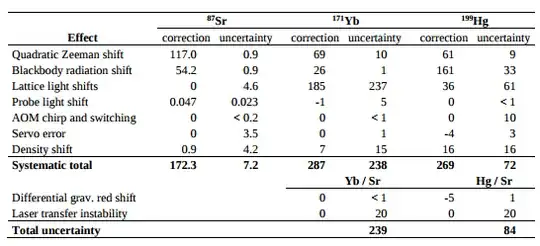
  • With some perturbations, you know they exist, and you do your best effort to minimize them and to estimate their values (which will always be nonzero). Any serious metrological paper will contain an error budget in which they report all the different significant perturbations on the experiment and estimations on their magnitude.

    As an example, here is the one from arXiv:1505.03207, and you can find more examples via e.g. this arXiv search.

    enter image description here

    The blackbody radiation shift often makes an appearance in these budgets, and it is one of the hardest to estimate and reduce. It is generally quite small, which means it was swamped by all the other systematics from the development of the atomic clock in the 50s until technology brought down all the other systematics, in the 90s, to the point where the blackbody radiation shift became an important consideration.

    However, as you can see, it is only one factor among many that need to be estimated and controlled.

  • Once you've done your very best effort to identify all the possible effects that might perturb your ground state, or affect the accuracy of your results in some way, you still don't know whether there are any other effects that you might have missed. Unfortunately, by definition, the perturbations which you missed are impossible to quantify - if you could, they'd be in the known unknowns category.

    There is really no way to deal with this within a single experiment. The possibility of such effects can only be mitigated by producing many different implementations which are based on different physical principles and are as different from each other as possible. If we build two clocks with low known systematics using completely different schemes and they tick in step within the known uncertainties, this increases our confidence that we have indeed identified all the relevant systematics, at least at that level of precision.

    Nevertheless, the possibility of systematic errors which we're not yet aware of is taken very seriously by metrologists. Each lab as a unit can only really implement one clock at a time, but the field as a whole does its best effort to ensure we have many different approaches which can validate each other's values and uncertainties.


Addendum

At your (rude and abrasive) insistence I have taken a look at MTW's ideal clocks, as described in box 16.4. (Take this as a good example of how "provide in full" is not hard, requires minimal technical skills, and enables everyone involved to know what is being talked about.)

It is completely unclear to me how you propose to implement this, based as it is on free-falling mirrors which are somehow meant to maintain perfect alignment though they have no connection to each other. There are finer points such as radiation pressure on the mirrors and shot noise on the laser (both of which you should understand thoroughly before attempting to reply) but simply put, MTW's ideal clocks are just that: an idealization.

I stand by what I said:

There's no way to compare a clock's output with what it gave out yesterday, and definitely not without external assumptions.

Any clock you build will be made of atoms and it will remain on a non-freefalling worldline on Earth's surface (unless you send it to orbit, of course). Show me an actual, physical setup that can compare the frequency of an oscillator now with its frequency yesterday, and I will show you the assumptions it rests on.

As far as MTW's ideal clocks are concerned, the assumptions are essentially the temporal constancy of the speed of light, but this is because MTW completely redefine the basic unit of time.

Suppose that you could implement an MTW clock: you launch into orbit two mirrors and a caesium clock. You position your mirrors a length $L$ apart and you set them on a free-falling orbit, with a ray of light bouncing between them. By a happy coincidence, you can choose $L=\tfrac12 c/9 192 631 770\:\mathrm{Hz}\approx 18\:\mathrm{cm}$ as a convenient length at which one cavity round trip will correspond to one Rabi oscillations for the caesium atoms. The light and the atomic oscillators should therefore be completely in step.

Suppose, further, that for some reason after a number of orbits (probably quite large) the light in the cavity is no longer in step with the caesium atoms, and does $n$ round trips for every $n'\neq n$ caesium oscillations. Can you conclude that the frequency standard has changed?* As it turns out, this is an ill-defined question. How can you distinguish that conclusion (i) from the alternative interpretations that (ii) the distance between the mirrors changed, or (iii) the speed of light did?

To decide whether (ii) is true, you can accompany your setup by a ruler (i.e. an actual ruler made of atoms) which can measure the distance between the two mirrors. There are two possible outcomes to this: the distance either changes or it doesn't. If the distance changes, do you conclude that space expanded? Or that the atoms in the ruler contracted? Either is a perfectly valid explanation, and the only difference between the two is what you define 'length' to be.

If the distance between the mirrors, as measured by the ruler, doesn't change, then you are exactly on the setup discussed here. The speed of light, as measured in atomic units, changed. Or, the atomic unit of time (as a geometric length in spacetime) changed. You are attempting to measure the change of a dimensionful constant, and this is impossible without external assumptions: constancy of atomic time for the first, and constancy of the speed of light for the second. Both interpretations are indistinguishable even in principle.

However, in practice, the conclusion to draw is in fact that the speed of light changed. The reason for this is that us humans, and everything around us, are made of atoms, and therefore we are built on (fixed) multiples of the atomic length and we operate on (fixed) multiples of the atomic timescale. If the atomic unit of time expands by two, we cannot notice, as our brains and clocks will slow down to match. Indeed, the only observable effect is that light now covers twice the distance in the same amount of time. As far as humans are concerned, it's light that sped up.


* Note that I am leaving measurement error out of this discussion. If you actually tried to implement this, it should be clear which of the two components - the optical clock and the magical set of freefalling perpetually-aligned mirrors - is more susceptible to experimental error.

Emilio Pisanty
  • 137,480
0

I don't know if I'm right, but here is an attempt to estimate one effect that might be relevant. If a 133Cs atom of mass $m$ is in thermal equilibrium with blackbody radiation at temperature $T$, then it has an average kinetic energy $(1/2)mv^2=(3/2)kT$. This will cause Doppler shifts. The longitudinal Doppler shift cancels out on the average, but the transverse Doppler shift, which is by a factor of $\gamma$, doesn't. The average effect is $\gamma-1=3kT/2mc^2$. I suppose the cesium has to be a gas, so the minimum actual temperature would be 944 K. Putting this in, I get $\gamma-1\sim 10^{-12}$. This seems below the $\sim10^{-10}$ precision implied by the number of sig figs in the standard, but maybe it's anticipated that future improvements in technology would make it relevant.

-1

is there any requirement to measure whether the durations of 9 192 631 770 periods of different primary frequency standards and/or of the same primary frequency standard in different trials, had been and remained equal to each other, by (presumably) unambiguous means (such as the "ideal clocks" described in MTW §16.4) ?

There's no explicit mentioning of such a requirement that I know.

However, if some unambiguous means of comparing durations (such as the "ideal clocks" described in MTW §16.4) were taken into consideration then the comparison of durations of oscillation periods allows(1) to conclude

  • whether any one given instance of an oscillator (such as a "primary frequency standard") had been constantly "perturbed" (even possibly including having been constantly "un-perturbed"), or variably perturbed; for whatever expected or unexpected "reasons", and

  • whether or not any two given primary frequency standards had been equally perturbed (even possibly including having been constantly "un-perturbed"), or not; for whatever expected or unexpected "reasons".

Related considerations are conveniently presented in response to issues raised by this answer which had been posted earlier, from which the following quotes were taken:

how [...] to implement this

There's no strict requirement to actually implement an "ideal clock" according to MTW's description; but merely to judge and quantify (or even only to estimate) how the relation between given setup participants differs from having constituted such an "ideal clock", to be "corrected" as suitable.

(Similarly there's no strict requirement to actually implement "caesium atoms unperturbed by black body radiation"; but the requirement presents a definitive ideal relative to which the given primary frequency standards should be "corrected".)

Still it may be asked which sort of observational data might be the basis of such a quantification at all(2). Looking at the illustration of MTW Box 16.4 I'd think foremost of the (possible) appearance (or disappearance) of "interference patterns" involving the relevant setup constituents.

external assumptions [...] Suppose that you could implement an MTW clock: you launch into orbit two mirrors and a caesium clock. [...] The light and the atomic oscillators should therefore be completely in step.

(To simplify the discussion: let's say this is found during an "initial setup phase" of at least $n'$ caesium oscillations.)

Suppose, further, that for some reason after a number of orbits (probably quite large) the light in the cavity is no longer in step with the caesium atoms, and does $n$ round trips for every $n' \ne n$ caesium oscillations.

First to note regarding "orbits" is that the MTW prescription (as quoted in the excerpt) involves certain necessary "precautions", or (arguably) "corrections". If $n$ represents the corresponding "precise" number, and correspondingly $n' \ne n$ caesium oscillations were found during the "trial phase" then:
the mean oscillation frequency of the caesium atomic oscillators had changed in comparison to the "setup phase"; it had been "perturbed" differently in the "trial phase", in comparison to the "setup phase".

How can you distinguish that conclusion (i) from the alternative interpretations that (ii) the distance between the mirrors changed,

Certainly the (relevant, "cautious" or suitably "corrected") tick duration of the orbiting MTW clock remained constant; as a matter of definition.

Of course, the tick duration(s) (or "ping duration(s)", or "signal roundtrip duration(s)"), either as "corrected", or "uncorrected" ("raw"), may be taken as measures of "spatial separation" between relevant setup constituents;
typically (for formal distinction from all sorts of other durations) with some fixed symbolic non-zero prefix attached, such as "$c_0$", or "$c_0/2$".

or (iii) the speed of light did?

It is certainly absurd that a mere and supposedly fixed (non-zero) symbol such as "$c_0$" should have changed from "setup phase" to "trial phase"; at all, and especially by a real number value "$n / n' \ne 1$".

you can accompany your setup by a ruler (i.e. an actual ruler made of atoms)

But relevant is surely not just any actual ruler made of atoms, but only such actual rulers made of atoms for which the "spatial separation between its two ends" (or "between two relevant marks") remained equal to a significantly better ratio than the real number value "$n / n' \ne 1$".
So how to determine which of all given or even all imaginable rulers satisfy this requirement? (The SI "metre" definition should give a valuable clue.)

The definitions (idealized thought-experimental descriptions) of how to measure "duration" and "spatial separation" are of course human conventions.
But there are very explicit and useful guidances on which of all imaginable conventions are preferrable, namely Einstein's assertion:

All our well-substantiated space-time propositions amount to the determination of space-time coincidences {such as} encounters between two or more material points.;

in fulfillment of Bohr's requirement:
{W}e must employ common language {...} to communicate what we have done and what we have found.

in practice [...] us humans, and everything around us, are made of atoms, and therefore [...]

... therefore we may want to determine their possible "perturbations", trial by trial, even if we had not expected them, and even if we have not yet pinned down their possible "reasons".


Notes (added after the initial posting):

1: Utilizing the notion of "ideal clocks" as described in MTW §16.4, a concrete definition of a duration unit (fittingly called here one "artefact second") might be the following:

"The artefact second is the duration of 9 192 631 770 periods of the radiation corresponding to the transition between the two hyperfine levels of the ground state of the caesium 133 atoms of the NIST primary frequency standard, referred to being at rest, at a temperature of 0 K, starting at UTC date January 1st, 2000, 00:00:00 .
This definition refers specificly to the artefact second being distributed in reference to the Marzke-Wheeler procedure."

2: That is, only as far as it is considered impractical to gather observational data which is explicitly required for carrying out the Marzke-Wheeler procedure, and thus to identify a suitably dense network of "ideal clocks"; including explicit coincidence determinations such as at the tick event preceding event $\mathcal{ C }$ in the first illustration of MTW box 16.4.

user12262
  • 4,360