12

OK, lets formulate it differently and say water works as a blue passing / red restricting filter.

It is actually observable. Just do a dive in a swimming pool with white light (maybe even at night) and a pool with a metal casing or white tiles. The further you look, the more blue it is.

So why is this so? Why is water not transparent?

And how does it happen on a molecular, subatomar or electron shell level?

Do 'red' waves become absorbed and retransmitted as 'blue' light waves or do only the 'red' waves get absorbed and the 'blue' can pass?

Can Maxwell help?

Robetto
  • 243

1 Answers1

15

I can't give a complete answer because it seems there is still some research ongoing.

Unlike what most people have been taught, water is not colorless. At least, large masses of water will be seen blue, such as the sea or a swimming pool.

enter image description here

(Left: tube filled with (light) water. Right: tube filled with heavy water.)

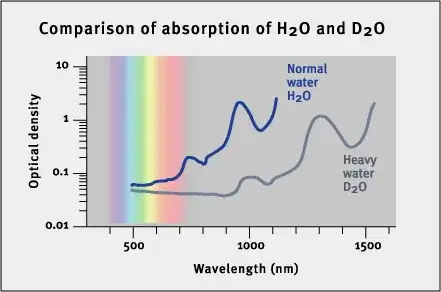
The fact is that water absorbs mostly the red wavelength. The reason is vibrational , unlike most materials which have its color thanks to electronic absortion, Rayleigh scattering, diffraction...

This vibrational mechanism means that water molecules will be excited into higher frequency vibrational modes (like a guitar string). This is not the case of deuterated water, as you can see.

enter image description here

Note that in the cases of the sea, there are more reasons involved, like scattering due to impurities and reflection.

You can read more here: http://en.wikipedia.org/wiki/Electromagnetic_absorption_by_water, http://www.webexhibits.org/causesofcolor/5B.html and http://www.dartmouth.edu/~etrnsfer/water.htm.

jinawee
  • 12,675
  • 7
  • 60
  • 102