6

Given this nuclear reaction:

$^3_1\mathrm H\to {}^3_2\mathrm{He}+e^-+\bar{\nu}$

and knowing the binding energies:

$BE(^3_1\mathrm H)=8.48 \,\mathrm{MeV}$

$BE(^3_2\mathrm{He})=7.72 \,\mathrm{MeV}$

If I calculate the mass defect (obviously considering the binding energies in the mass calculation) I obtain a positive value:

$M(^3_1\mathrm H)c^2=2809.08 \,\mathrm{MeV} > M( ^3_2\mathrm{He})c^2+M(e^-)c^2=2808.991 \,\mathrm{MeV}$

as expected for a spontaneous decay. Considering the binding energies I have written above I expect the $^3\mathrm{H}$ to be more stable than $^3_2\mathrm{He}$.

My question is: why does this decay occur?

rob
  • 96,301
Chaos
  • 955

4 Answers4

8

Binding energy simply isn't the right metric (because it is calculated from different starting points on account of the differing masses of the constituent nucleons).

Proper energy (AKA mass) of the states is the right metric.

Wolfram Alpha gives the masses as

$$M_{\mathrm{T}} = 2809.432 \,\mathrm{MeV}$$ $$M_{^3\mathrm{He}} = 2809.413 \,\mathrm{MeV}$$

In other words, there is about 19 keV to be had in this decay.

3

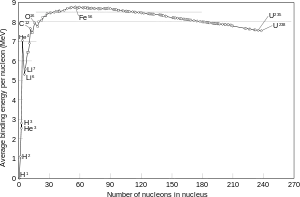
The binding energy is not the only factor that affects the stability of nuclei.

nuclear binding

It is also whether the nucleus is proton rich or neutron rich.

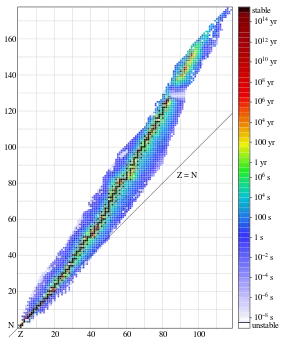
Look at the stability curve for isotopes:

isotopes

Isotope half-lives. Note that the plot for stable isotopes diverges from the line Z = N as the element number Z becomes larger

Tritium is neutron rich and this gives a window of probability for one of the neutrons to decay.

He3 is proton rich, and a stable isotope, because the one neutron playing ball with the charged protons manages to stay on the stability line. In the end it is an observational fact. It could only go back to tritium by electron capture and the binding energies do not allow it, as protons do not decay.

anna v
  • 236,935
2

I did not check your mass defect calculations, but, as far as the binding energy is concerned, it is defined as "the energy required to disassemble a whole system into separate parts" (http://en.wikipedia.org/wiki/Binding_energy ). So my guess is the binding energy of tritium is the energy required to disassemble it into two neutrons and a proton, whereas the binding energy of Helium-3 is the energy required to disassemble it into a neutron and two protons, but a neutron is heavier than a proton, so I guess the mass of tritium is greater than that of Helium-3, although its binding energy is higher.

akhmeteli
  • 27,962
0

All parties are to be congratulated for asking such 'key' question and exploring answers regarding 'conventionally' calculated 'binding energy' of H-3 and He-3 and the stability of each!

I suggest (like Sears & Zemansky illustrated in their standard, much used old 'College Physics' textbook) that H-1, the neutral Bohr Atom mass, and specifically its mass 'u' be used as the starting ingredient toward imagining building final nuclei, in fusion energy calculations, regardless of whether it's He-4 (starting with 4 Bohr atoms), ---- or He-3 or H-3 (starting with 3 Bohr atom masses for each of them too)! ((Ultimately, the Sun, net results, builds He-4 with (4) H-1 Bohr atoms.))

The basic problem (minor flaw) is starting with the unstable free neutron in calculations for building toward 'neutrons inside' the end-product nucleus! That 'micro-manages' the 'micro-system, and is like giving a horse whose body tends tends not to absorb static charge -- and unfair head start. The free neutron is a decay-prone 'particle', and not ideally suitable to start with as a basic starting raw material ingredient. Using a 'free neutron mass' in some 'binding energy calculations, might lead to helpful outcomes, but gets into great trouble in a few cases.

Kyle Kanos
  • 29,127