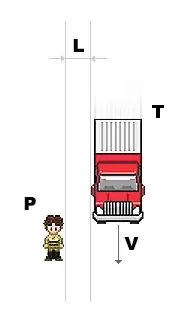
The truck will have in its wake some unknown mass of air almost moving with a speed $v$ comparable to the truck's speed $\bf V$. The pressure behind the truck will be lower than the pressure at the sidewalk because air pressure follows the Bernoulli equation,
$$ P_\mathbf{P} = P_\text{road} + \frac{1}{2}\rho v^2,
$$
where $\rho \approx 1~$kg/m$^3$ is the air density. For a truck at 60 mph $\approx$ 30 m/s, this is a pressure difference of 450 Pa, or 0.004 atm.
If the pedestrian is very near the wake of the truck (note that this wake will extend partway into the buffer zone $\bf L$), they might feel this pressure difference $\rho v^2/2$ across their torso. The force depends on the orientation and area of the pedestrian. My torso is about a meter long and about 0.4 meter wide, so I could feel a force as large as 180 N. That's equivalent to about 20% of my body weight, or the lateral force that I'd feel leaning at an angle of about 10º. I can recover from a 10º lean, but I have to be ready for it.
All of these numbers should be taken as coarse approximations, because I've ignored turbulence. Turbulence will play a huge role in the dynamics here, especially for finite $\bf L$. However the order of magnitude is probably correct.