-1

Can space be created or destroyed? Is space conserved? I am not asking for matter,energy and time. Its just a question about conservation of space

PS: I am asking for what was there before big bang. Surely Big bang would require space in the first place...

Tom Lynd
  • 475

3 Answers3

1

The "scientific view of creation" is the Big Bang. It's as widely accepted as gravity. Nobody doubts it exists, we're mostly discussing how it works.

As for the conservation of energy, that basically states that at two points in time the total amount of energy is equal. You need those two points, though. And there is no proof that there is a point in time before the big bang. Lacking one of those two points in time, we cannot say that energy is conserved between the pair. It would be the sound of one hand clapping.

Your last question is even worse in that respect: "What was there when space didn't exist." That presupposes both the existence of a there and a when.

MSalters
  • 5,649
0

Since practical science creates mathematical models to describe the observable reality as good as possible, the question of creation is quite irrelevant here.

Nonetheless it might be interesting philosophical question how a "physical creationism" might look like while acknowledging what we know scientifically in physics.

The physics department of the University of Durham has regularly poster contests and there was a poster about "God as a principle of cosmological explanation".

They have stated a non-temporal god who would affect all physical laws at the same time, so that we have a consistent perception of reality and time.

While this is not relevant for actual physics, I find it refreshing to occasionally ponder the wider philosophical questions implicitly posed by modern physics like "What was 'before' the big bang?" or "Could the universe actually be a simulation and how would we know it?". This question of scientific creationism and this poster are hence a nice way to pass some idle time.

EDIT: I'm including the picture since the link seems to be broken for some people. the original caption stated: "Please note that I have removed the name of the author, in what I believe to be in his best interest. This copy was made for the sole purpose of academic discussion. The original is on public display at Durham University. The copyright remains with the author."
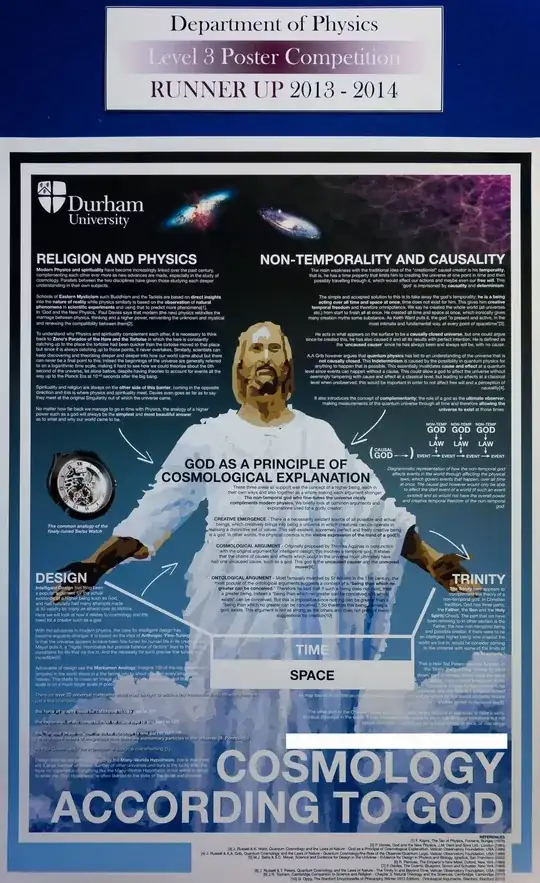
The original caption stated: "Please note that I have removed the name of the author, in what I believe to be in his best interest. This copy was made for the sole purpose of academic discussion. The original is on public display at Durham University. The copyright remains with the author."

0

Some Richard Feynman quotes which I think clarify the scientific view on this sort of question:

  • "Religion is a culture of faith; science is a culture of doubt."
  • "I can live with doubt and uncertainty and not knowing. I think it is much more interesting to live not knowing than to have answers that might be wrong."

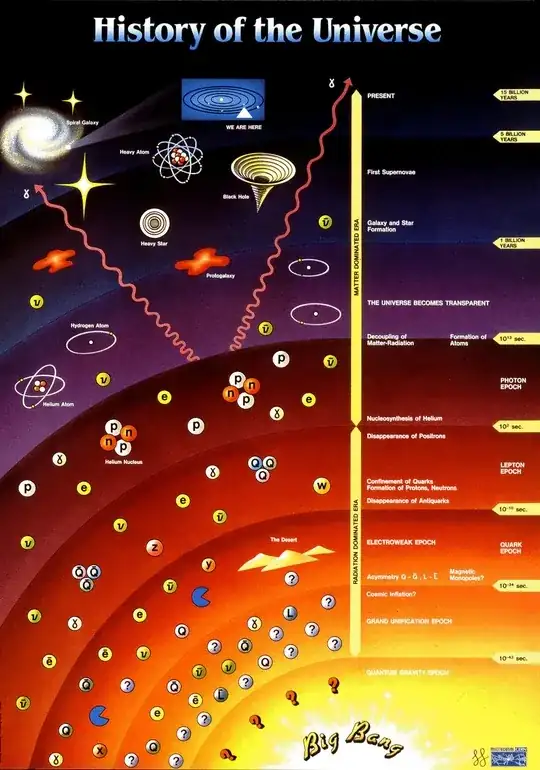
Physicists have learned a lot about the history of our universe during the last two centuries. In fact, some of the most beautiful theories (where beauty means agreement between experment and theory) have come from this front. What we know is pretty well summarized in the picture below.

We know that time as we know it started with a big bang, leaving a hot soup of particles. Minor asymmetries and quantum fluctuations blown up by a period of rapid expansion gave rise to the matter dominated universe we see today.

What happened before the big bang? We don't know yet. It isn't clear if it even makes sense to talk about it. People are free to fill in whatever story they want about that time, but science has nothing to say about it at the moment.

History of the universe from palaeos.com/cosmos/images/cosmichistory.jpg