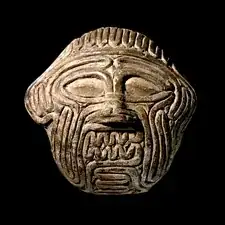
Clay mask of the demon Huwawa, The British Museum. From Sippar, southern Iraq, about 1800-1600 BC.
Huwawa was a demonic creature, of neither mortal nor godly origin, created by Enlil to guard the forest of Lebanon :
I never knew a mother who bore me, nor a father who brought me up! I was born in the mountains...
He is described in The Epic of Gilgamesh, tablet 2, as:
Humbaba's roar is a flood, his mouth is death and his breath is fire! He can hear a hundred leagues away any [rustling?] in his forest!
He was not, however, a mechanical creature such as a robot, as such things did not exist in Ancient Mesopotamia. He had human characteristics, and a physical body which Gilgamesh could capture:
they pulled out his insides including his tongue.
(tablet 5, The Epic of Gilgamesh)
And:
Huwawa bared his teeth at him [...] He tied up his arms like a captured man [...] Huwawa sat down and began to weep, shedding tears...
He is also easily slayed by Enkidu:
Enkidu, full of rage and anger, cut his throat...
Furthermore, Enlil adds further evidence to Huwawa's mortal characteristics when, upset by Huwawa's death, he cries out:
He should have eaten the bread that you eat, and should have drunk the water that you drink.
(all quotes from Gilgamesh and Huwawa unless mentioned)
He appears, then, to be a monstrous but mortal creature. Parallels have been drawn between the stories of Huwawa and Medusa(1), because of their similarities of a hero beheading a demonic creature.
Source:
- Clark Hopkins, "Assyrian elements in the Perseus–Gorgon story," American Journal of Archaeology 38 (1934:341-ff)