5

First, I apologize if this is asked in the wrong place, but I'm finding it hard placing this question, which is this:

5-pointed star

The symbol above is called a "star", but why?

I have read that the symbol predates the telescope, but stars do not look five-pointed to the naked eye. Possibly it was only called a star very recently, but perhaps the origins are much older and more mythological. If so, then maybe somebody here can clarify the issue for me, or at least point me in the right direction?

bleh
  • 6,718
  • 5
  • 33
  • 75
Zorawar
  • 175
  • 1
  • 4

3 Answers3

6

This turned out to be interesting - thanks for the question.

Wiktionary - Etymology From Middle English sterre, from Old English steorra (“star”), from Proto-Germanic *sternô, *sternǭ (“star”), from Proto-Indo-European *h₂stḗr (“star”).

Arabic: نَجْم‏‎ (ar) m (najm), نَجْمَة‏‎ f (najma), كَوْكَب‏‎ (kawkab)

Egyptian Arabic: نجمة‏‎ f (negma)

Egyptian: sbꜣ Egyptian star

Old High German: sterno

• Gothic: f (stairnō)

• Greek: αστέρι (el) n (astéri), άστρο (el) n (ástro)

Ancient Greek: ἀστήρ m (astḗr), ἄστρον n (ástron)

• Hebrew: כּוֹכַב‏‎ (he) m (kokháv)

• Hindi: तारा (hi) m (tārā), सितारा (hi) m (sitārā)

• Old Norse: stjarna f


http://www.huffingtonpost.com/mario-livio/the-five-pointed-star-as_b_6192742.html

Mario Livio
Astrophysicist

A pentagram appears on a jar dated to 3100 BCE, found north of Thebes in Egypt. The incision appears to have been done in one continuous motion,....

(Snip) Interestingly, pentagrams from the same period were found in Mesopotamia. Those included a five-pointed star on a tablet from Uruk, dated to about 3200 BCE; a design on a vase dated to 3000 BCE from Jemdet Nasr; and another design in spindle whorl from the same time, also from Jemdet Nasr.

(Snip) In Sumarian and Akkadian cuneiform texts, the meaning of the five-pointed star was the “regions of the inhabited world.” Thus, we can find it in sentences such as: “which are not the regions warmed by the brightness of your light.”

(Snip) Historian A. de la Fuÿe speculated that the pentagram could have originally been an anthropomorphic symbol of Hygeia, the Greek goddess of health (Figure 3). While the connection appears tenuous, it shows the level of interest that the five-pointed star has generated over the years.


https://goo.gl/CngUb6

Thoughout history stars have been represented in many different ways. One of the most common today is the 5 pointed star, but 4,6,7,8 and even more points have been used. Some cultures also represented stars more like they are seen in the sky, as dots, or small circles. The 5 pointed star might have originated from the way the Egyptians represented the star in hyroglypics. If you look at a really bright star sometime you might notice that it does appear to have lines coming out from it. These are called diffraction spikes and appear because of the way the light enters your eye which is a small circular hole. (Astronomers are very familiar with diffraction because it provides the fundamental limit to the detail we can make out in distant objects). I suspect that the ultimate origin of the pointed star is those spikes, although that's just an educated guess.

tblue
  • 719
  • 8
  • 14
0

Words not much different from 'star' are generally found in languages closer to the Mediterranean, that is, the farther north you move the greater the chance to find a markedly different word (e.g. slavonic languages, gaelic etc). So one could conjecture that 'star' was something from Near East culture and the obvious origin would be the goddess Ishtar. She was notoriously connected with the planet Venus whose apperances on the sky are probably the best known astronomical fact. The Babylonians knew that Venus-Ishtar is best seen as the morning star every 1.6 years. But after 5 successive appearances in various seasons, that is 5x1.6=8.0 years, a cycle becomes obvious. Graphically, a cycle with step 1.6 years, taken modulo 360 is 144 degrees(1), so the appearances form a pentagram 0, 144, 288, 72, 216, 0.

Did the Babylonians connect Ishtar and the graph or was the connection a Greek invention, it is a matter of speculation, but anyway the fact is remarkable enough(2). And of course it provides an explanation why the pentagram is called a star and how this spread around the world.

(1)Modern observations have given a slightly different period, so the graph is rather kinky, as shown in wikipedia) (2)There is no clue how to connect the Egyptian symbol, which is the skeleton of a pentagram, but is most probably something older.

sand1
  • 836
  • 5
  • 10
-4

So a little more poking around has led me to an answer. The physics of why a spherically symmetric star appears to have spikes is an optical effect called diffraction. A good explanation is provided on this wikipedia page. Most telescopes have legs that support the secondary mirror (all labelled 3 below):

telescope

The light rays entering the telescope diffract off these legs to produce spikes in the resulting image, effectively encoding the loss of information caused by the legs (i.e., the legs have obscured some of the light entering the telescope):

enter image description here

See also this stackexchange question and here for more details and further interesting links.

Now, my question was why were stars still drawn with diffraction spikes when telescopes had not been invented yet. Well, citing the links here:

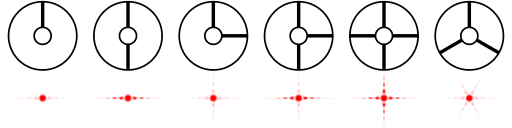
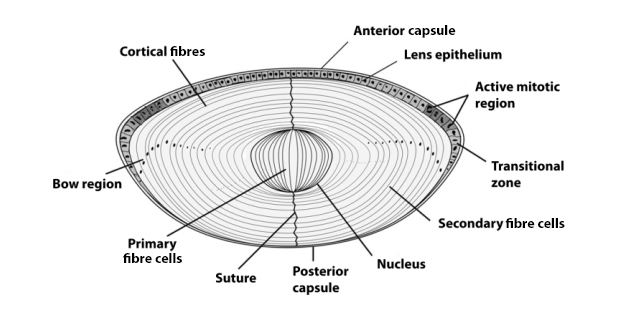
The diffraction spikes are apparently caused - in a very similar way - by the suture lines of the lenses in one's eyes. Essentially, the suture joints cause light passing through the lens to diffract along those lines producing a similar optical effect to the supporting legs of a mirror in telescopes.

enter image description here

So, it appears that the pointed star shape may well have been called a star from very early on, and it may well be because people really had seen stars as pointed objects from the very beginning; there appears to be no other mythology behind it than that.

Zorawar
  • 175
  • 1
  • 4