2

I was reading an article and it states

Tightness has returned to the London Metal Exchange (LME) aluminium spreads.

The focus point this time around is the December-January spread (CMALZ4-F5), which flared into $25 per tonne backwardation late last week.

That was acute enough to pull the full benchmark cash-to-three-months period into the widest backwardation since December 2012.

Basically, what does it mean by an aluminium spread, and what does it mean by the spreads are getting tighter? I don't really understand what backwardation means.

Also, what does "cash-to-three-months period into the widest backwardation" mean?

Richard
  • 33
  • 1
  • 4

1 Answers1

5

The aluminum generally trades in contango, meaning that the longer the maturity of the future contract (i.e. the farther in the future the delivery date) the more expensive the contract. A simple explanation is that to deliver aluminum to you in 5 years, I need to buy the aluminum now at whatever the current price is and store it for 5 years, which has a cost.

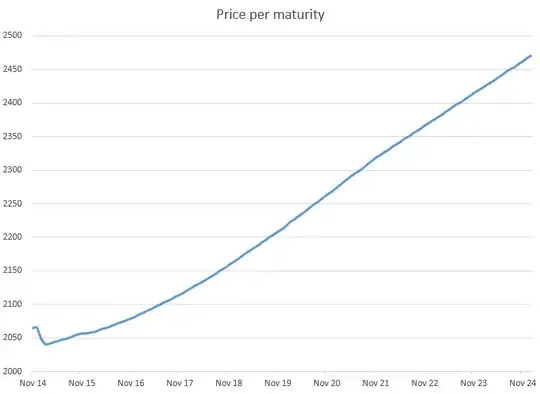
However at the end of October the maturity curve looked like this:

enter image description here

So although the long term trend was in line with theory there was a local anomaly and the January 15 contract closed at $ 2047 /MT vs. $ 2066 /MT for the December 14 contract. The spread in that context is simply the price difference between the two contracts. According to the article the spread went as high as $25 intraday.

The "cash-to-three-months benchmark" is the spread between the spot price and the 3 month future contract.

For non seasonal commodities, that kind of anomaly is generally due to a local shortage of supply which makes getting the product sooner more difficult.

Wikipedia has more on backwardation and contango.

assylias
  • 1,682
  • 8
  • 13