26

I just bought a house. Now I'm getting ads in the mail every day or two trying to get me to sign up to pay my mortgage bi-weekly (every two weeks) or weekly instead of monthly. In their words I could cut seven years and thousands of dollars off what I pay in long term. It seems like I would be paying the exact same amount of money, also.

I know "if something sounds too good to be true then probably it is". But I cannot figure out why in this case. What is the catch? Or is this something I should be signing up for ASAP?

JoeTaxpayer
  • 172,694
  • 34
  • 299
  • 561
New homeowner
  • 323
  • 1
  • 3
  • 5

8 Answers8

51

So the principle is true. Assuming that you get paid bi-weekly, you end up getting three paychecks two months during the year. Typically that is in a 31 day month and about 6 months apart. So if things were different, and your mortgage was setup so you paid half a monthly payment each paycheck, then you would wind up making one full extra payment per year. Making that extra payment, most often, reduces the mortgage by 7 years on a 30 year note.

While true, many of these companies charge exorbitant fees for the right for you to do so, so the principal reduction is not commensurate with what you are paying.

You can simply do this yourself without paying fees. On those extra pay days, pay half a payment to principal only, and no fee, no fuss. This is pretty easy to do with most mortgage companies as they have online payments and it is just a matter of filling out a web form. For me this does not even cost a stamp as they pull from my checking account at another bank.

Pete B.
  • 80,097
  • 16
  • 174
  • 245
30

Pete and Noah addressed the math, showing how this is, in effect, converting a 30yr to a ~23yr mortgage, at a cost, plus payment about 8% higher (1 extra payment per year). No magic there.

The real issue, as I see it, is whether this is the best use of the money.

  • Do you have a 401(k) at work and do you deposit to the match?
  • Are all your credit cards always paid in full?
  • Any other debt at higher interest?
  • A fully funded emergency account?
  • Any other expenses you need to save for?

Keep in mind, once you pay extra principal, which in effect is exactly what this is, it's not easy to get it back. As long as you have any mortgage at all, you have the need for liquidity, enough to pay your mortgage, tax, utilities, etc, if you find yourself between jobs or to get through any short term crisis.

I've seen people choose the "sure thing" prepayment VS the "risky" 401(k) deposit. Ignoring a match is passing up a 50% or 100% return in most cases. Too good to pass up.

2 points to add - I avoided the further tangent of the tax benefit of IRA/401(k) deposits. It's too long a discussion, today's rate for the money saved, vs the rate on withdrawal. Worth considering, but not part of my answer. The other discussion I avoid is Nicholas' thoughts on the long term market return of 10% vs today's ~4% mortgage rate. This has been debated elsewhere and morphs into a "pre-pay vs invest" question.

JoeTaxpayer
  • 172,694
  • 34
  • 299
  • 561
18

When you pay monthly, you're making 12 payments / year. Assuming you have a payment of $1000/mo, that's $12,000/year that you're paying for your mortgage.

When you opt for bi-weekly, they're saying that you can pay half of your mortgage ($500) bi-weekly (can be configured to align with your paycheck). Since there are ~26 bi-weekly periods in a year, you're making 26 * $500 = $13,000 in mortgage payments each year.

Some of these companies charge a fee for you to utilize this service. The main concept behind this is that people are horrible at budgeting on their own, so when $500 is immediately taken from your paycheck, you'll be able to budget around what's left and be able to make that extra payment each year without thinking about it or realizing it.

Noah
  • 4,173
  • 1
  • 21
  • 41
2

Making extra principal payments will reduce the term of your loan. I wouldn't sign up for a biweekly schedule, just do it yourself so you have more flexibility. A simple spreadsheet will allow you to play "What if?" and make it clear that extra principal payments are most effective early in the term of the loan. My wife and I paid off our home in less than 10 years with this approach. Some will say that the opportunity costs of not using that money for something else outweighs the gains. I would say that not having a mortgage has a positive impact on your cash flow and your assets (you own the home), which combine to create more opportunity, not less. That being said, It should be obvious that paying off higher interest debt first is the priority, (Paying off a zero percent interest car loan early is just foolish)

Elder Geek
  • 123
  • 4
1

Another thing to consider is that paying extra principal (either via one of these services, or by including something extra with your normal mortgage payment and designating that it go to principal rather than be held to reduce next month's payment, or just sending an additional payment to the bank and designating it as reducing the principal) shortens the term of your loan.

Is this good? Maybe. Consider that banks lend with a variety of terms. Usually the 15-year fixed rate mortgage has a lower interest rate than the 30-year fixed-rate mortgage, and the 5-year home-equity-loan has an even lower rate.

When you prepay your loan, your interest rate stays the same, but the bank gets its money back sooner. This makes more profit for the bank as it can then invest the money in other things. That profit could have been yours if you had made that investment instead of prepaying your mortgage.

Snowbody
  • 302
  • 1
  • 5
1

I'll preface this with saying that I'm not a finance or real estate professional, this is just how I understand the situation and what I'm doing:

We just got a 30year/FHA mortgage, there's no prepayment penalty, and no fees associated with paying it biweekly. In fact (Wells Fargo), while the payments get withdrawn biweekly, they don't actually post to the mortgage until there's enough for a full payment.

So essentially here are the benefits I'm realizing:

  1. It's easier to budget when the money immediately leaves my paycheck, rather than having a big balance in my checking account tempting me when it's earmarked for the mortgage
  2. The extra money going against the mortgage gets credited against the principal, not the interest, so I'm building equity. My goal is racing to build enough equity to get rid of the PMI. Since in the early years of a mortgage the scheduled payments are almost entirely against the interest, extra payments are the only way to build this equity. Perhaps once I've got the PMI lifted and I've got enough equity to feel comfortable, then I can scale back and start paying less, but that's a few years away.
thehole
  • 287
  • 2
  • 7
1

Interest is a fee that you pay in order to use someone else's money. Once you've made the deal, pretty much anything you do that reduces the total interest that you pay does so by reducing the time for which you get to use their money. As an extreme example, consider a thirty-year interest-only loan, with a balloon payment at the end. If you pay it off after fifteen years you pay half as much interest because you had the use of the money for half as long. The same thing happens when you make biweekly payments: you reduce the total interest that you pay by giving up the use of some of the borrowed money sooner. That's not necessarily bad, but it's also not automatically good.

Pete Becker
  • 5,551
  • 1
  • 23
  • 24
-1

Depending on who you have the loan through and how they figure the interest charges (whether daily, monthly, bi-monthly, etc. normally monthly I would assume), your interest is probably figured either daily or once a month.

Let's assume that it is figured daily, otherwise it wouldn't make sense to make bi-weekly payments.

At 4% Annual Interest on a $150,000 home loan the interested added each day is about $16.44, but it doesn't stop there because it is compounding interest daily so the next day it becomes 4% of 150,0016.44 (which is negligibly larger amount) and they will tack on another $16.44.

So what will happen is that the amount of interest you owe grows rather quickly, especially if you miss a monthly payment. Everyone knows that the faster you pay something off the less interest you pay, but not everyone knows the formula for compounding interest. a quick Google search rendered this site with a simple explanation

Compound Interest Formula
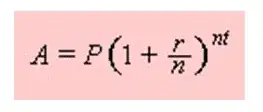
Compunding Interest Formula

unfortunately this formula doesn't take into account the payments being made.

The big thing with making your payments bi-weekly rather than a bigger payment once a month is that you pay off some of that principle right away and it won't collect interest for 14 more days.

if the interest is only calculated once a month, make your full payment before the interest is calculated, the same goes for your credit cards.

Malachi
  • 163
  • 6