9

So as I approach retirement age, many people are out there suggesting annuities as a way to fund retirement. It's seductive, as they typically have around a 6% payout, that is 100K buys you 6k worth of income for the rest of your life.

However, what they fail to mention is that when you die they keep the principal paid in. So on the surface it looks like you are getting a 6% return on your investment, but for your heirs/estate that is not the case.

So assuming you pay in 100K, and live for 25 years, you would get a total of 150K for your 100K. But since they keep that initial 100K, your real gain is only 50K. This comes out to a 2% rate of return. But that is not totally correct: it is less than that as the 6K in year 25 is worth much less than the 6k in year one.

I feel like the real rate of return is around 1.75% given the above stats, but I am not good enough to do the math. I have not found a formula which accounts for the life insurance company keeping the money after you die.

Anyone have such a formula?

psmears
  • 184
  • 4
Pete B.
  • 80,097
  • 16
  • 174
  • 245

5 Answers5

17

your real gain is only 50K.

You are correct about the nominal gain in dollars (ignoring inflation). It is $50,000.

This comes out to a 2% rate of return. But that is not totally correct

This is incorrect in every way. The nominal gain is $50,000 but you can't just say that the "average interest" is $50,000 / 25 / $100,000, because you limited yourself to 25 years only. It became an Annuity, not a Perpetuity.

The actual nominal interest rate is 3.397% (ignoring inflation). In this calculator, you paid $100,000 at the beginning, got $6,000 each year for 25 years, and is left with $0 at the end of 25 years, and made a nominal gain of $50,000.

You can imagine that you are a bank lending $100,000 to the insurance company, and the insurance company is paying you back $6,000 for each of 25 years (last year is still $6000 payment, not $100,000). The $6,000 each year includes both principal component and interest component. It is literally a loan that needs to use Amortization Table.
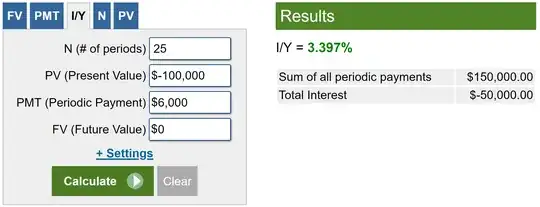
Annuity

In fact, if you live long enough (e.g. 100 years since buying), the annuity becomes a perpetuity, where the actual nominal interest rate is very close to 6.000% (ignoring inflation).
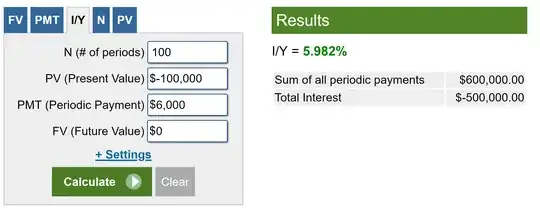
Perpetuity

So how do you account for inflation? There are 2 ways:

  1. You don't. You simply compare the expected nominal interest rate of 2 products, i.e. 6% annuity of 25 years vs 25 years United States Treasury Fixed Interest.

  2. You compare the expected nominal interest rate of 2 products above and deduct the Federal Reserve target inflation of 2% from both products. This is meaningless in making decisions. One product's inflation won't be magically different from another product's inflation.

For reference this is the 6% annuity product:

Years Alive Nominal Interest Rate
5 -30.191%
10 -8.351%
15 -1.289%
20 1.803%
25 3.397%
30 4.306%
35 4.860%
40 5.215%
45 5.449%
50 5.608%

Given that long term United States Treasury Fixed Interest rate is around 4.5%, I would say that you need to be alive for around 33 years to break even.

*I forgot to say that there is no "formula" for interest rate per year. You need to rely on the algorithm of the Financial Calculator or Excel. Alternatively, binary search to solve an equation. In Excel it is:

=RATE(25,6000,-100000,0,0)
base64
  • 10,480
  • 2
  • 27
  • 39
10

See other answers about annuities They are very much an insurance product; you are paying someone to guarantee you an ongoing income no matter what investments are doing, for your entire life and/or the lives of everyone on the policy if you have written it to cover survivor(s?). They have run the numbers and are willing to bet that the market does well enough and/or you (and survivors) will die early enough that they can not only afford this specific payment but will probably make a significant profit. You are taking the opposite side of that bet, which their statistics say is probably the losing side.

You are also betting that the contract survives; if the insurer goes bankrupt their insurance may not be good enough to fully meet their commitments. (Then again, that's not too much more risk than of a bank failing and having to rely on the FDIC. Large insurers are the size of, and sometimes are, large banks.)

As always, the alternative is to self-insure. Just set up an investment strategy that you have sufficient confidence in that you like the odds better. Long-term "market rate of return" has been around 8%, and it isn't hard or especially risky to get about that return, if you have the patience and reserves to wait out bad years. There certainly is risk, but as always you need to balance that against reward.

Run your own numbers for both options, and consider whether the security is worth the cost. And shop around; each insurance company runs its own numbers and may make substantially different offers. If are considered a preferred risk, some companies may offer more. I got a better than average offer through my employer's retirement plan, for example, apparently because technogeeks who make it to retirement are apparently considered slightly lower risk than the general population.

In my case, I have purchased a smallish annuity (costing me around US$100k) to supplement the social security safety net (when I start taking that), but am really planning on self-insuring and living on my investments. Your balance points may be completely different. Remember to consider legacy if any when deciding how much to buy.

"Live long and prosper!"

keshlam
  • 52,634
  • 6
  • 87
  • 177
6

Other than the math error as base64 illustrated, your intuition is correct. Your actual return starts negative and climbs to 6% the longer you live.

It's important to remember that annuities are not investments, they are insurance. Just like life insurance protects you from dying too early (leaving your heirs with debts or losing a source of income), annuities are insurance against dying too late, meaning you outlive your retirement savings.

Also like any insurance, you should not expect to make money off of them; they are priced such that the insurance company, when issuing thousands of annuities, makes a profit on average. Some people will make a higher return by living a long time, some will be unlucky (in 2 ways) by dying early.

what they fail to mention, is that when you die they keep the principle paid in

If your planner "fails to mention this" then you need to find a new planner. They are probably only interested in selling you products rather than helping you plan for your future and protect from unplanned events. A good planner should explain all of the details of what you are buying, why you are buying them, and what the risks are.

If it's just friends or acquaintances suggesting this, then that are just uninformed. Which is fine, I am uninformed on plenty of things; I just try (sometimes unsuccessfully) to inform myself before making decisions that affect me or my family's future significantly.

There are other actual investments that can give you close to 6% return on average and preserve at least part of the capital invested. They may go down in value over time but you will not lose everything at death. Ask your advisor about fixed-income mutual funds (which invest in bonds, they do not guarantee a specific rate of return themselves) that are relatively safe (or at least safer than something like the S&P 500) and provide periodic income. If you don't need the income until you die, you can reinvest it and keep the the principal up until you do need the income.

D Stanley
  • 145,656
  • 20
  • 333
  • 404
2

I’m in the situation and looking myself. Annuity has the benefit that the money is guaranteed to never run out until the moment you die. In a savings account and drawing out money, you may still have $100,000 in the bank the moment you die, which is useless to you. Or you run out of money 10 years before you die, which is worse than useless.

The insurance company will make profit from you individually if you die early and lose money on you individually if you live for long. Since they have 10,000 customers they pay out to make some profit on average. For you as an individual, “some profit on average” is no good.

The only thing you can do is comparing offers from different companies and with different terms. The simplest terms would be “pays until you die”. I could chose “continues paying my wife until she dies, at 100%, 66% or 50% of my rate”. I could chose “pays X to my heirs if I die within ten years” to avoid the annoyance of signing the deal and being run over by a car the next day. You can have an automatical annual increase.

Each set of terms changes the payout. Your only choice is comparing different payouts, different insurance companies, and accept the best offer that you find acceptable.

The biggest variable is how long you live, and you cannot change that.

gnasher729
  • 25,147
  • 9
  • 49
  • 83
0

If we say that the "fair" discount rate is d, then after n years, your principal will be worth Pd^n.

For instance, suppose we use a discount rate of 96%, and you die after 25 years. Then that means that there's $100*0.96^25 = $36k of present value that's going away. If we subtract that from the original amount, we find that we have $64k of present value left. That is, you're only getting 64% of that 6%, so your effective interest rate is 3.84%.

Now, a discount rate of 96% corresponds to an interest rate of 4.17%, which is more than the effective interest rate. A "fair" discount rate would get you an effective interest rate that matches the discount rate. So my initial guess of 96% being a fair discount rate wasn't quite right. If you want to get the exact value, you can put the math into Excel and do goal seek, and you'll find that the proper effective interest rate is 3.3976%.

There's no closed form formula for this; any calculator is going to use numerical methods.

Acccumulation
  • 10,727
  • 21
  • 47