6

Almost every motorcycle I have seen has its air intake mounted such that it is sucking in air from the direction opposing travel.

According to fluid dynamics, if the intake is made to face forwards, the engine would benefit from ram-air effect, which can result in higher engine power output.

Now the Wikipedia article does say:

While ram-air may increase the volumetric efficiency of an engine, they can be difficult to combine with carburetors, which rely on a venturi-engineered pressure drop to draw fuel through the main jet. As the pressurised ram-air may kill this venturi effect, the carburetor will need to be designed to take this into account; or the engine may need fuel-injection.

Surely a carburetor can be reengineered to suit the change in pressure profile across the intake? Plus, even motorcycles with fuel injection have their intakes point backwards.

Zaid
  • 39,276
  • 50
  • 151
  • 294

5 Answers5

7

First of all by "most production motorcycles" I am assuming commuter level motorcycles used in South and South East Asia

its not true that all production motorcycles have intakes facing backwards, its more or less a ergonomics based design decision , some motorcycles have intakes facing 90 degrees to the side. Some have them facing towards the back as you say.. For example the intake duct location on the TVS Apache Series.
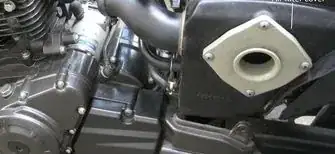
enter image description here

A common point in all of these mass production motorcycles is that they use carburettors

Your point on Ram air effect on carburettor is correct it will cancel out the venturi effect but reingnieering the carb to make use of the Ram air effect only works if there is a specific way air can be channeled to the intake via a duct or port which is not the case In case of a commuter bike..

  • secondly Ram air effect will work only when you achieve a specific speed , most production motorcycles are not designed to go at high speeds to use the advantages provided the Ram air effect .

Update: There is literally no point in making a intake face in the forward direction when the engine is at the back of the intake , you will need additional space to bend the intake tube which will create ergonomic issues and frankly there is no need to do the exercise , iterating my previous point,(please dont mind the bad drawing)
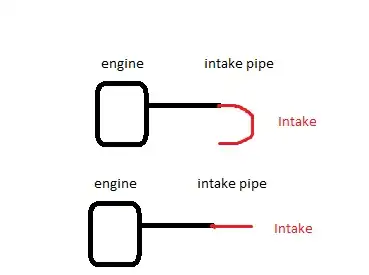
enter image description here

  • You neeed a specilized channel or duct to force air to the intake which is not there in these commuter segment bikes which are mostly naked.
  • These bikes do not have the necessary top speed to achieve the advantage of the RAM air intake effect. Most of these bikes have a top speed of 60MPH.
  • Agreeing to the points mentioned by ALLman, having the intake facing in the backwards direction also prevents weather and road debris from entering the engine through the intake.
Shobin P
  • 8,966
  • 14
  • 41
  • 74
6

You guys are looking at it from the wrong angle...

It’s not about the carb or the ram sur effect, it is all about the exhaust.

The exhaust side of the cylinder is the hottest side so it needs to be facing forward so it’s gets a bit of cooling.

Plus if you’d put the exhaust facing backward it could get too warm where the cables and electronic are, under the seat.

Simon
  • 61
  • 1
  • 2
1

Perhaps a forward facing intake would be good for the engine but the disturbance it would create in the air infront of the bike would be quite bad for handling, straight line stability and completely negate the effect of the fairing.

On a basic commuter bike, the problems with a forward facing inlet would be compounded by bikes that are ridden in all weathers. In heavy rain they would be susceptible to ingesting moisture and in low temperatures they could suffer from icing

Steve Matthews
  • 23,464
  • 2
  • 41
  • 92
0

In my opinion while designing the vehicle, designers consider the density of air coming into the air box. Because of the vihicle design air boxes are fixed behind the engine. So the air in front of the air box will be coming through the engine cooling fins. Which make it hot and reduces the density. Inordar to get cold and fresh air designers will never provide the air inlet mouth directed towards the engine.

0

Kawasaki introduced “ram air” in the 1990s with the ZX-11 (US, elsewhere the ZZR-1100), and from there it appeared in other models.

The Zx-11 was carbureted at the time, which required the ram air intake (which led to increasing pressure in the air box) to have an additional air path from a central tube to pressurize the fuel bowl. So if you see photos or diagrams, that’s what the central tubes are in the front air intakes.

It was marketed as a performance feature.

Tim B
  • 712
  • 4
  • 12