Proof
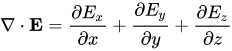
We can approximate the integral of the divergence over the volume by the finite sum by dividing densely the space inside the volume  into small cubes with the edges
  and the corners
 ![{\displaystyle [x_{i},y_{j},z_{k}]}](../cb6b5b79ea0bf253343b99d0d5fd84b496014aa6.svg) as well as approximating three of the coordinate derivatives
by their difference quotients. We will keep the edges coordinate names for the convenience even if they are equal.
We get
as well as approximating three of the coordinate derivatives
by their difference quotients. We will keep the edges coordinate names for the convenience even if they are equal.
We get
![{\displaystyle \int _{V}\nabla \cdot \mathbf {E} \,\,dV=\sum _{i,j,k}\left[{\frac {E_{x}(x_{i+1},y_{j},z_{k})-E_{x}(x_{i},y_{j},z_{k})}{dx}}+{\frac {E_{y}({x_{i},y_{j+1},z_{k}})-E_{y}(x_{i},y_{j},z_{k})}{dy}}+{\frac {E_{z}(x_{i,j,k+1})-E_{z}(x_{i,j,k})}{dz}}\right]dxdydz+\Theta (dxdydz)}](../902a03789b94fd07a1c6984d184dedea5053e7fd.svg)
Let us focus on a single contribution to this sum related to the derivative with respect to a chosen coordinate for example  i.e.
for example
i.e.
for example  . For a fixed
  we have
![{\displaystyle \sum _{i}{\frac {E_{x}(x_{i+1},y_{j},z_{k})-E_{x}(x_{i},y_{j},z_{k})}{dx}}dxdydz=\sum _{i}[E_{x}(x_{i+1},y_{j},z_{k})-E_{x}(x_{i},y_{j},z_{k})]dydz}](../5293dea2757437fc2a9c7b9153fe6842adbf0cc9.svg)
Note now that because of the alternating signs the vast majority of terms in the right sum vanish and we have
![{\displaystyle \sum _{i}[E_{x}(x_{i+1},y_{j},z_{k})-E_{x}(x_{i},y_{j},z_{k})]dydz=[E_{x}(x_{1},y_{j},z_{k})-E_{x}(x_{0},y_{j},z_{k})+E_{x}(x_{2},y_{j},z_{k})-E_{x}(x_{1},y_{j},z_{k})+...+E_{x}(x_{n},y_{j},z_{k})-E_{x}(x_{n-1},y_{j},z_{k})]dydz}](../ce87a5b6f6d333f360ee407d225b3b6bc995b025.svg)
which reduces only to two terms or
![{\displaystyle \sum _{i}[E_{x}(x_{i+1},y_{j},z_{k})-E_{x}(x_{i},y_{j},z_{k})]dydz=[E_{x}(x_{n},y_{j},z_{k})-E_{x}(x_{1},y_{j},z_{k})]dydz}](../00dcb974765b90bc83075ffea04858c3d0cb0197.svg)
where the bordering ![{\displaystyle [x_{n},y_{j},z_{k}]}](../30a5cf997cfc99e31e574fa7f8eca36915ac7b99.svg) and
and ![{\displaystyle [x_{1},y_{j},z_{k}]}](../d6102d133dd88e6b2a6b0947a1cb583acaafc286.svg) with the first coordinate obviously depending on the choice of
with the first coordinate obviously depending on the choice of  and
and  are such that those points are the closed to the
surface
are such that those points are the closed to the
surface  containing the volume .
Also note that while  is an infinitesimal (small) element of the surface parallel to the
  plane and for the unite vector
 ![{\displaystyle \mathbf {n} _{x}=[1,0,0]}](../d89c27715904aa381f4a8453b810af7e9ff65409.svg) perpendicular to it
perpendicular to it  and so for the second point the right side is an approximate to the growth
  of the surface integral
  i.e.
i.e.
 ,
,
![{\displaystyle -E_{x}(x_{1},y_{j},z_{k})]dydz=\mathbf {E} \cdot d\mathbf {S} +\Theta (dydz)}](../61ec0910059546ecfd1be811ce13f7da60751a91.svg) ,
,
Repeating the estimate for the two other dimensions and coming back to the original sum we get
![{\displaystyle \int _{V}\nabla \cdot \mathbf {E} \,\,dV=\sum _{j,k}[E_{x}(x_{n_{j,k}},y_{j},z_{k})-E_{x}(x_{1_{j,k}},y_{j},z_{k})]dydz+\sum _{i,k}[E_{y}(x_{i},y_{n_{i,k}},z_{k})-E_{y}(x_{i},y_{1_{i,k}},z_{k})]dxdz+\sum _{i,j}[E_{z}(x_{i},y_{j},z_{n_{i,j}})-E_{z}(x_{i},y_{j},z_{1_{i,j}})]dxdy+\Theta (dxdydz)}](../377682afc87963f420129a3a65d772b625671d20.svg)
so the right side is the approximate surface integral (sum over the surfaces of the cubes closest to the surface ) of the field itself projected on the outward unit vector field which proves the therem i.e.
 .
.
![{\displaystyle {\mathbf {E} }({\mathbf {x} })=[E_{x}(x,y,z),E_{y}(x,y,z),E_{z}(x,y,z)]}](../9f01aea42054732ced690a038d7248f704daa06a.svg)